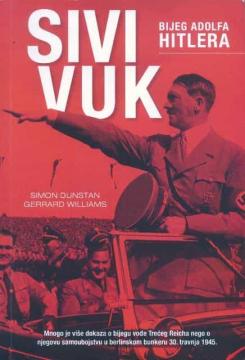
Sivi vuk: Bijeg Adolfa Hitlera

Sivi vuk: Bijeg Adolfa Hitlera

Simon Dunstan, Gerrard Williams

In the book, two British publicists reject the official version of the Fuhrer's death and present a shocking theory, for which there is ample evidence... Is it possible that the leader of the Third Reich really escaped justice?

In this book, two British publicists reject the official version of the Fuhrer's death, according to which he and Eva Braun committed suicide in a bunker in Berlin on April 30, 1945. Instead, they point to ample evidence, which they collected over five years, that the couple fled Berlin at the end of World War II to start life anew in a Nazi-controlled enclave in fascist Argentina. Hitler lived comfortably and happily until 1962 and even had offspring.

In an underground bunker in Berlin on April 30, 1945, before the invasion of the victorious Soviet Red Army, Hitler's loyal associates killed their volunteer doubles - a non-commissioned officer of the Wehrmacht and a "third class" actress!

The book, which immediately became a bestseller in Great Britain, is named after the pseudonym of the leader of the Reich - the Gray Wolf - which was given to him by his closest associate - Martin Bormann, back in 1943, while he was working on the evacuation plan. . Bormann devised a plan to "dislocate" the top Nazi leadership from Germany to South America, in case the fortunes of war turned against Berlin.

While filming a series of documentaries in Argentina on the occasion of the anniversary of the Falklands War, Gerrard Williams came across an interesting story about Adolf Hitler. There he met many people who were sure that Hitler had escaped from Germany and was living in their country. He decided to team up with his old friend, writer, videographer and photographer specializing in military history - Simon Dunstan. What they discovered shocked them both. There is much more evidence of the Reich leader's escape than of his death.

Original title
Grey Wolf: The Escape of Adolf Hitler
Translation
Tamara Novak
Editor
Enes Begulić
Dimensions
21 x 14 cm
Pages
407
Publisher
Begen d.o.o., Zagreb, 2013.
 
Latin alphabet. Paperback.
Language: Croatian.
ISBN
978-9-53274-224-4

No copies available

The last copy was sold recently.
 

Are you interested in another book? You can search the offer using our search engine or browse books by category.

You may also be interested in these titles

Osječka NOU brigada

Osječka NOU brigada

Zdravko B. Cvetković
Vojnoizdavački zavod, 1981.
Croatian. Latin alphabet. Hardcover with dust jacket.
8.34
Hrvatska u arhivima izbjegličke vlade 1941-1943.: Izvještaji informatora o prilikama u Hrvatskoj

Hrvatska u arhivima izbjegličke vlade 1941-1943.: Izvještaji informatora o prilikama u Hrvatskoj

Ljubo Boban

Academician Ljubo Boban, in his work Croatia in the Archives of the Government in Exile 1941–1943, brings together a collection of diplomatic reports from various European and international representative offices of the Yugoslav government in exile during

Globus, 1985.
Croatian. Latin alphabet. Hardcover with dust jacket.
9.52
Zračni desanti i građanska obrana

Zračni desanti i građanska obrana

Branko Injac
Izdavačko poduzeće "27. srpanj", 1954.
Croatian. Latin alphabet. Hardcover.
7.98
Kapetanova ratna sjećanja

Kapetanova ratna sjećanja

Stojan Vojnović

Stojan Vojnović (1920-1994), a Croatian writer, journalist and participant in the National Liberation War, in his memoirs Captain's War Memories (1983) provides a deep, introspective look at the war events of World War II in Yugoslavia.

Božidar Maslarić, 1983.
Croatian. Latin alphabet. Paperback.
4.32 - 4.34
Mafija esesovaca

Mafija esesovaca

Victor Alexandrov

In this book, the author describes in detail how a precisely thought-out plan on the secret continuation of the activities of the SS, which was created during World War II, was put into practice.

Globus, 1982.
Croatian. Latin alphabet. Hardcover with dust jacket.
7.98
Pijesak Orijenta

Pijesak Orijenta

Fitzroy MacLean

The memoir The Sands of the Orient (1949), part of the autobiographical work of the British diplomat, soldier and writer Fitzroy Maclean (1911–1996), describes his adventures in the diplomatic service and World War II.

Znanje, 1981.
Croatian. Latin alphabet. Paperback.
6.24