U pustinji i prašumi

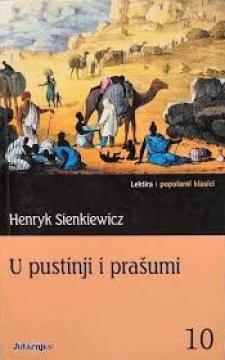
U pustinji i prašumi

Henryk Sienkiewicz

Staś Tarkowski and little Nel Rawlinson are kidnapped during the Mahdi's rebellion in Africa. The children flee through the Sahara Desert and the rainforest, facing danger, hunger, and wild animals.

In the Desert and in the Jungle (1911) is the most famous Polish children's and adventure novel, although it is also read with pleasure by adults. The work was written as a gift from Sienkiewicz to his grandchildren and quickly became a classic of world literature for young people.

The action takes place in the 1880s in Egypt and Sudan during the Mahdist rebellion against Egyptian-British rule. Fourteen-year-old Staś Tarkowski, the son of a Polish engineer, and eight-year-old Nel Rawlison, the daughter of an English administrator, are kidnapped by the Mahdists. The children manage to escape from slavery and embark on an epic journey home through the dangerous African wilderness.

They are accompanied by their faithful dog Saba, a black boy Kali (who joins them), and later by other characters. The journey takes them across the scorching Sahara, swamps, jungles and rivers. They encounter lions, elephants, crocodiles, hunger, thirst, disease and a warrior tribe. Staś shows extraordinary courage, resourcefulness and knowledge, while little Nel conquers everyone with her kindness and courage.

The style is lively, dynamic and full of exotic descriptions of African nature. Although Sienkiewicz had never been to Africa, he extremely convincingly depicted the landscapes, animals and the state of the continent at that time using numerous travel and scientific works.

In the Desert and in the Jungle has undergone numerous translations and film adaptations (the most famous are the Polish versions from 1973 and 2001). The book has been an entrance to the world of adventure and courage for generations of Polish children.

Original title
W pustyni i w puszczy
Translation
Iso Velikanović
Illustrations
Corbis
Graphics design
Halid Malla
Dimensions
19.5 x 12.5 cm
Pages
302
Publisher
Jutarnji list, Zagreb, 2004.
 
Latin alphabet. Paperback.
Language: Croatian.
ISBN
9-53-716041-6

Two copies are available

Copy number 1

Condition:Unused

Copy number 2

Condition:Used, excellent condition
 

Are you interested in another book? You can search the offer using our search engine or browse books by category.

You may also be interested in these titles

Mirza

Mirza

Henryk Sienkiewicz
Mlado pokolenje, 1967.
Serbian. Latin alphabet. Hardcover with dust jacket.
3.98 - 3.99
Mali vitez

Mali vitez

Henryk Sienkiewicz
Mladinska knjiga, 1974.
Slovenian. Latin alphabet. Paperback.
3.84
Smogovci i strašni Bongo

Smogovci i strašni Bongo

Hrvoje Hitrec

In the novel, the cheerful Vragec family from Dubrava, Zagreb, faces new adventures. When the mysterious Bongo appears, the boys explore a series of comical and tense events, preserving kindness and togetherness.

August Cesarec, 1987.
Croatian. Latin alphabet. Hardcover.
6.32
Pripovijetke

Pripovijetke

Vjenceslav Novak

This edition brings four key stories by Vjenceslav Novak (1859–1905), one of the most important Croatian realists, known for his social sensitivity and depictions of urban poverty at the turn of the 19th and 20th centuries.

Zagrebačka stvarnost, 2001.
Croatian. Latin alphabet. Hardcover.
6.36 - 7.32
Povjestice

Povjestice

August Šenoa

The collection includes the following short stories: "The Shoemaker and the Devil", "The Stone Wedding", "The House of the Kug", "The Fall of Venice" and "The Death of Petar Svačić", with which this famous writer occupies a special place in the history of

Profil International, 2008.
Croatian. Latin alphabet. Hardcover.
13.269.28
Dekameron

Dekameron

Giovanni Boccaccio

In the Decameron, ten young people fleeing the plague tell stories about love, fate and ingenuity. The adapted version of Ljerka Car Matutinović brings selected novellas, adapted to school, with an emphasis on humor, morality and Renaissance spirit.

Mozaik knjiga, 2002.
Croatian. Latin alphabet. Hardcover.
5.76