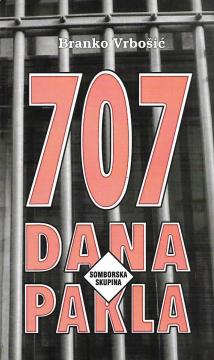
707 dana pakla: "Somborska skupina" od akcije i zatvora do slobode
Rare book

707 dana pakla: "Somborska skupina" od akcije i zatvora do slobode

Branko Vrbošić

The book describes in detail the experiences of the so-called "Sombor groups" - Croatian group "Uskoci" - which had the task of demolishing the bridge near Sombor during the Homeland War.

At the end of January 1992, members of the Independent Usočka Company from Osijek tried to mine the bridge over the Danube near Batina. They failed. Three defectors - Zlatko Turković, Darij Galeta and Zoran Križevac - were killed in an ambush by "territorials" from Baranja, and the eight prisoners suffered terrible abuse in Serbian casemates for two years. The author of the book follows their arrest, their stay in Serbian prisons and their eventual release, providing a rare insight into the personal stories and sufferings of the group's members during the 707 days of imprisonment.

Editor
Josip Cvenić
Illustrations
Josip Petrić
Dimensions
20 x 12 cm
Pages
167
Publisher
Matica hrvatska, Osijek, 1994.
 
Latin alphabet. Paperback.
Language: Croatian.

No copies available

The last copy was sold recently.


Are you interested in another book? You can search the offer using our search engine or browse books by category.

You may also be interested in these titles

Osječka bibliografija I-II: Tiskarsko-izdavačka djelatnost u Osijeku od 1742. do 1978. godine

Osječka bibliografija I-II: Tiskarsko-izdavačka djelatnost u Osijeku od 1742. do 1978. godine

Marija Malbaša

The capital bibliography of printing and publishing activities in Osijek from 1742 to 1978 lists thousands of books, newspapers, magazines and small print, regardless of language. A classic of Croatian bibliographic creativity of the 20th century.

Jugoslavenska akademija znanosti i umjetnosti (JAZU), 1981.
Croatian. Latin alphabet. Hardcover.
The book consists of two volumes
48.32
Starohrvatska seoska zajednica

Starohrvatska seoska zajednica

Miho Barada

In his work Starohrvatska seoska zajednica (The Old Croatian Village Community) (1957), Miho Barada analyzes the social and agrarian organization of early medieval Croatian villages, their institutions, ownership relations, and common land based on origin

Jugoslavenska akademija znanosti i umjetnosti (JAZU), 1957.
Croatian. Latin alphabet. Paperback.
10.00
U modi: Kultura odijevanja porečkih plemenitih građana (1650.-1720.)

U modi: Kultura odijevanja porečkih plemenitih građana (1650.-1720.)

Elena Uljančić

The book represents a novelty not only in Istrian, but also in Croatian historiography. Namely, the clothing culture in the region of Istria in the early modern period has not yet been analyzed at all, and for the region of Dalmatia only sporadically.

Srednja Europa, 2019.
Croatian. Latin alphabet. Hardcover.
16.99
Knezovi, kraljevi, biskupi

Knezovi, kraljevi, biskupi

Neven Budak

Probably every historian sometimes feels the need to fantasize about the people they write about, to try to immerse themselves in the times that are the subject of their scientific research.

Slobodna Dalmacija, 2005.
Croatian. Latin alphabet. Paperback.
6.00
Izabrani radovi

Izabrani radovi

Ljubo Boban

Selected Works of Academician Ljubo Boban (2022) brings together key texts on contemporary Croatian history of the 20th century. The foreword by Damir Agičić highlights Boban's methodological rigor and objectivity in researching sensitive topics.

Srednja Europa, 2022.
Croatian. Latin alphabet. Hardcover.
24.52
Liburnijske teme 8: Brseč i Brešćina

Liburnijske teme 8: Brseč i Brešćina

"Liburnian Topics" represent a valuable serial publication (proceedings) initiated by the Chair of the Čakavian Parliament in Opatija with the aim of researching and preserving the historical, cultural and natural heritage of the Liburnian region.

Čakavski sabor, 1994.
Croatian. Latin alphabet. Paperback.
12.36