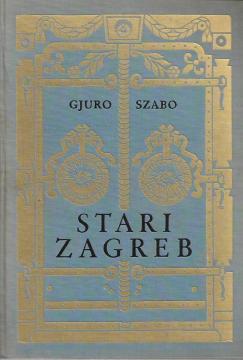
Stari Zagreb

Stari Zagreb

Gjuro Szabo

A classic work of Croatian historiography, published in 1941, which provides a fascinating overview of the historical development of Zagreb, from its earliest mentions to Szabin's time, and is an indispensable source for anyone who wants to better underst

The book is divided into chapters that chronologically and thematically follow the development of Zagreb. Szabo describes in detail:

  1. Medieval Zagreb
  • Foundation of the diocese in 1094.
  • The origin and development of Gradec and Kaptol as two separate entities.
  • The life of the inhabitants in the Middle Ages, the defense of the city, feudal relations and conflicts between Gradec and Kaptol.
  1. The Renaissance and Baroque period
  • Urban development of Zagreb.
  • Construction of churches, monasteries and noble palaces.
  • Influence of the Habsburg Monarchy and cultural flourishing.
  1. Development in the 19th century
  • Modernization of Zagreb during the era of the Illyrian movement.
  • The arrival of the railway, the construction of modern buildings and the expansion of the city towards the south.
  • Development of institutions such as theaters, museums and universities.
  1. Zagreb in the 20th century
  • Changes in the political and social life of the city.
  • Modernization of infrastructure and the arrival of new styles in architecture.

Szabo does not only write about political history, but also about the everyday life of citizens, customs, trade, crafts and cultural achievements. The book is richly illustrated with drawings, maps and photographs documenting the historical appearance of Zagreb.

"Old Zagreb" is not only a historical overview but also a sentimental record of a city that is constantly changing. Gjuro Szabo skilfully captures the spirit of Zagreb, making this work indispensable for lovers of history, urban planning and culture.

Editor
Drago Zdunić, Franjo Buntak
Illustrations
Milan Babić, Tošo Dabac, Vilko Zuber, Milan Pavić
Dimensions
24 x 17 cm
Pages
220
Publisher
Spektar, Zagreb, 1971.
 
Latin alphabet. Hardcover.
Language: Croatian.

No copies available

The last copy was sold recently.
 

Are you interested in another book? You can search the offer using our search engine or browse books by category.

You may also be interested in these titles

Osječka groblja

Osječka groblja

Stjepan Sršan

The book is deeply rooted in the local history and culture of Osijek, with an emphasis on cemetery motifs that serve as a metaphor for memory, death, and disappearance.

Povijesni arhiv u Osijeku, 1996.
Croatian. Latin alphabet. Paperback.
5.26
Hrvatski vladari 1-5.

Hrvatski vladari 1-5.

Neven Budak
Večernji list, 2012.
Croatian. Latin alphabet. Paperback.
The book consists of 5 volumes
12.34 - 15.32
Pazin

Pazin

Petar Strčić

Pazin is a town in central Istria, known for its rich history and natural beauty. It is located above the karst abyss of Pazinska jama, into which the river Pazinčica plunges.

Skupština općine Pazin, 1982.
Croatian. Latin alphabet. Hardcover with dust jacket.
15.62
Istočna Hrvatska: Osijek – Vukovar – Ilok (zbornik radova)

Istočna Hrvatska: Osijek – Vukovar – Ilok (zbornik radova)

The collection contains papers from the international scientific conference, Eastern Croatia: Osijek – Vukovar – Ilok, held in 1999.

Pedagoški fakultet, 2002.
Croatian. Latin alphabet. Paperback.
7.986.38
Šifra 777

Šifra 777

Đorđe Ličina
Centar za informacije i publicitet (CIP), 247.
Croatian. Latin alphabet. Hardcover with dust jacket.
5.38
Vojskovođa Svetozar Boroević 1856-1920.

Vojskovođa Svetozar Boroević 1856-1920.

Milan Pojić

Svetozar Boroević, the most capable Austro-Hungarian military leader of the First World War, the only Croat who received the title of field marshal and was awarded the highest Austrian decorations, has been systematically hushed up in Croatian history.

Hrvatski državni arhiv, 2006.
Croatian. Latin alphabet. Paperback.
5.46