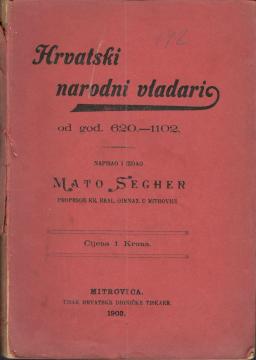
Hrvatski narodni vladari od god. 620.–1102.
Rare book
Antique

Hrvatski narodni vladari od god. 620.–1102.

Mate Sagher

A pioneering attempt at a systematic presentation of Croatian political history from the settlement of Croats to the conclusion of a personal union with Hungary. Segher chronologically traces the development of Croatian statehood, relying on the sources a

The work begins with a description of the arrival of the Croats in the territory of present-day Croatia around the 7th century, and the establishment of the early principalities. He places special emphasis on the rule of the princes of the Trpimirović dynasty, who consolidated power and laid the foundations of Croatian statehood. Segher discusses in detail the reign of King Tomislav, the first Croatian king, and his successors, including Petar Krešimir IV. and Dmitri Zvonimir.

The book also analyzes internal political struggles, relations with Byzantium, Frankishness, and Hungary, and the impact of church reforms on political stability. The final part of the work is dedicated to the period after the death of King Zvonimir, which was marked by dynastic conflicts and the weakening of central authority, which culminated in the conclusion of a personal union with Hungary in 1102.

Segher's work, although written in the spirit of the historiography of the time, remains an important source for understanding the formation of the Croatian medieval state. His approach combines a narrative style with analytical insights, making the book accessible and informative for a wider audience interested in Croatian history.

Dimensions
19 x 13 cm
Pages
104
Publisher
Dionička tiskara, Mitrovica, 1903.
 
Latin alphabet. Paperback.
Language: Croatian.

One copy is available

Condition:Used, very good condition
Damages or inconvenience notice:
  • Damaged back
 

Are you interested in another book? You can search the offer using our search engine or browse books by category.

You may also be interested in these titles

Anđelko Mijatović: Bleiburška tragedija i križni put hrvatskoga naroda godine 1945.

Anđelko Mijatović: Bleiburška tragedija i križni put hrvatskoga naroda godine 1945.

Anđelko Mijatović

The Bleiburg Tragedy and the Way of the Cross of the Croatian People in 1945 is a historical-documentary work by Croatian historian and university professor Anđelko Mijatović.

HSK, 2007.
Croatian. Latin alphabet. Paperback.
6.624.63
Drinovci na dlanu ruke Njegove: Monografija naselja i župe

Drinovci na dlanu ruke Njegove: Monografija naselja i župe

The monograph "Drinovci in the Palm of His Hand" is the result of years of work by 23 authors and co-authors, mostly from Drinovci. This wonderful work represents the most comprehensive and beautiful publication about a Herzegovinian village and parish to

Crkva na kamenu, 2022.
Croatian. Latin alphabet. Hardcover.
76.24
Istočna Hrvatska: Osijek – Vukovar – Ilok (zbornik radova)

Istočna Hrvatska: Osijek – Vukovar – Ilok (zbornik radova)

The collection contains papers from the international scientific conference, Eastern Croatia: Osijek – Vukovar – Ilok, held in 1999.

Pedagoški fakultet, 2002.
Croatian. Latin alphabet. Paperback.
7.985.59
Balada o Nikoli Gorjanskom

Balada o Nikoli Gorjanskom

Vlado Nemet
Tilia, 1994.
Croatian. Latin alphabet. Hardcover.
2.98
Urotnička pisma Marina Držića - s faksimilima pisama

Urotnička pisma Marina Držića - s faksimilima pisama

Marin Držić

The Conspiratorial Letters of Marin Držić represent an exceptionally important document of Croatian political and literary history of the 16th century. With a reprint of the original manuscript of the Conspiratorial Letters and the "bill of exchange" of M

Sveučilišna naklada Liber (SNL), 1989.
Croatian. Latin alphabet. Paperback.
21.46
Zaraćeno poraće: Konfliktni i konkurentski narativi o stradanju i iseljavanju Talijana Istre

Zaraćeno poraće: Konfliktni i konkurentski narativi o stradanju i iseljavanju Talijana Istre

Franko Dota

The book analyzes how conflicting historical narratives about the suffering and mass emigration of Italians from Istria and Rijeka developed in Croatia and Italy after World War II (1943–1956), debunking myths and encouraging an empathetic approach to the

Srednja Europa, 2010.
Croatian. Latin alphabet. Paperback.
11.32