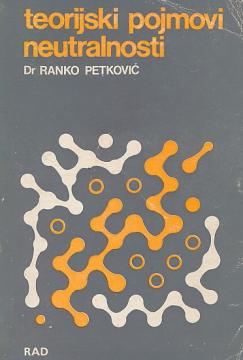
Teorijski pojmovi neutralnosti

Teorijski pojmovi neutralnosti

Ranko Petković

The work was created in the context of the Cold War and the strengthening of the Non-Aligned Movement, so the author considers neutrality as a political, legal and historical phenomenon.

The book "Theoretical Concepts of Neutrality" by Ranko Petković systematically analyzes different types and concepts of neutrality in international relations, political theory, and international law. Petković concludes that neutrality is not a static concept, but rather a historically and politically changing one. In international relations at the end of the 20th century, neutrality became a flexible strategy that extended from a legally defined status to a broad political concept such as non-alignment.

Editor
Dušan Paradopolos
Graphics design
Miloš Majstorović
Dimensions
20 x 13.5 cm
Pages
371
Publisher
Rad, Beograd, 1982.
 
Distribution: 2,000 copies
 
Latin alphabet. Paperback.
Language: Serbian.

One copy is available

Condition:Used, excellent condition
 

Are you interested in another book? You can search the offer using our search engine or browse books by category.

You may also be interested in these titles

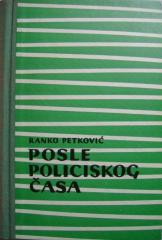
Posle policijskog časa

Posle policijskog časa

Ranko Petković
Rad, 1957.
Serbian. Latin alphabet. Hardcover with dust jacket.
3.99
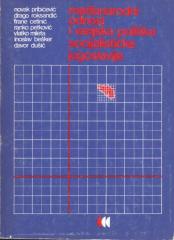
Međunarodni odnosi i vanjska politika socijalističke Jugoslavije

Međunarodni odnosi i vanjska politika socijalističke Jugoslavije

Novak Pribičević, Drago Roksandić, Frane Cetinić, Ranko Petković, Vlado Mileta, Inoslav Bešker, D...

The book analyzes the development and main characteristics of the foreign policy of the SFRY in the context of global and regional political relations, especially during the Cold War.

Naklada CDD, 1979.
Croatian. Latin alphabet. Paperback.
15.8211.07
Zašto je ubijen Ivo Pukanić?

Zašto je ubijen Ivo Pukanić?

Berislav Jelinić

The best-selling Croatian journalistic book of 2009. The author, long-time journalist and editor of Nacional Berislav Jelinić (who succeeded Pukanić as head of the weekly), wrote it just a year after the assassination on October 23, 2008 in Zagreb.

Sljedeći savjet, 2014.
Croatian. Latin alphabet. Paperback.
24.56
Oluja koju nismo mogli izbjeći

Oluja koju nismo mogli izbjeći

Ante Gugo

Ante Gugo explains the breakup of Yugoslavia, the formation of the Croatian state, and the circumstances that led to Operation Storm through a chronological account of events from 1985 to 1995.

Večernji list, 2015.
Croatian. Latin alphabet. Paperback.
18.42
Teorije zavjere 21. stoljeća

Teorije zavjere 21. stoljeća

Velimir Grgić

In his book "Conspiracy Theories of the 21st Century," Velimir Grgić takes readers on an exciting journey through the labyrinth of contemporary disinformation. With a focus on the digital age, Grgić dissects the phenomenon of conspiracy theories, revealin

24 sata, 2021.
Croatian. Latin alphabet. Paperback.
8.36