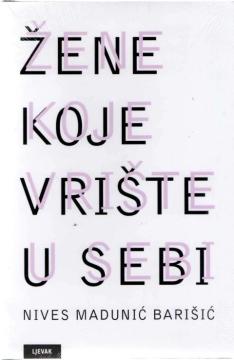
Žene koje vrište u sebi

Žene koje vrište u sebi

Nives Madunić Barišić

Lorna is a social worker, Urša is a retired harpist from the National Theatre, Tajra is a psychologist, and Tina is a very young mother and wife exposed to domestic violence.

When Tina seeks help at the Social Work Center, the lives of these four women begin to intertwine. While Lorna tries to understand when and how her own life slipped out of her hands, Urša struggles with unbearable poverty like most pensioners in Croatia, Tajra has a hard time dealing with prejudice, racism and her own rebellious character, and the youngest of them, Tina, lives exposed to daily brutal physical and verbal violence from her father-in-law and tries to protect her young sons and unborn child. Four women of different ages, destinies and personalities at a certain turning point in their lives are drawn into a web of relationships through which they change and finally free themselves.

Editor
Emica Calogjera Rogić
Graphics design
Ana Pojatina
Dimensions
21.5 x 14 cm
Pages
427
Publisher
Naklada Ljevak, Zagreb, 2024.
 
Latin alphabet. Hardcover with dust jacket.
Language: Croatian.

One copy is available

Condition:Used, excellent condition
 

Are you interested in another book? You can search the offer using our search engine or browse books by category.

You may also be interested in these titles

Usta puna zemlje

Usta puna zemlje

Branimir Šćepanović

The novel "Usta puna zemlje" (1970), the masterpiece of the Serbian writer Branimir Šćepanović, is a psychologically in-depth explorer of the limits of the human soul, solitude and existential freedom, reminiscent of Kafka and Camus.

BIGZ, 1987.
Serbian. Latin alphabet. Paperback.
3.98
Deobe 1-3

Deobe 1-3

Dobrica Ćosić

This work, awarded the NIN Prize for that year, is considered one of the most significant in Serbian literature after World War II.

Prosveta, 1961.
Serbian. Cyrillic alphabet. Hardcover with dust jacket.
The book consists of 3 volumes
11.42
Deobe

Deobe

Dobrica Ćosić

Deobe is a novel about the tragic division of Serbs into Chetniks and Partisans during World War II. Winner of the NIN Award, it is part of a wider epic trilogy, inspired by Ćosić's experiences and historical documents.

Prosveta, 1963.
Croatian. Latin alphabet. Hardcover with dust jacket.
13.74
Mramorna koža

Mramorna koža

Slavenka Drakulić

The novel, written in the first person, describes the complex, distant relationship between a sculptor (the narrator) and her mother. The main characters are the sculptor, a beauty mother obsessed with purity and bodily blemishes, and a stepfather, who en

Grafički zavod Hrvatske (GZH), 1989.
Croatian. Latin alphabet. Hardcover with dust jacket.
8.82
V.

V.

Thomas Pynchon

The novel represents a journey into an alternative world – a world that we all belong to from time to time, but of which we would not want to be a part, a world of paranoia and alienation that we are not entirely sure is just an alternative or the bare tr

Čarobna knjiga, 2010.
Serbian. Latin alphabet. Paperback.
21.98
Crna kutija

Crna kutija

Amos Oz

The Black Box is a kaleidoscope of married life and love relationships. It is a novel that implicitly speaks about all of us.

Hena Com, 2001.
Croatian. Latin alphabet. Hardcover.
10.988.24