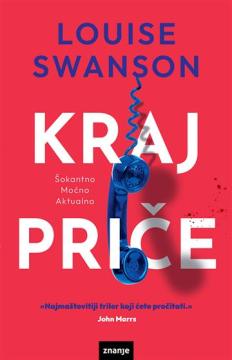
Kraj priče

Kraj priče

Louise Swanson

A powerful, moving, and timely thriller about censorship, art, and the healing power of fiction – perfect for dystopian lovers, but with a personal, intimate touch. Swanson wrote the novel during the pandemic, following a family tragedy.

The year is 2035. In a dystopian world after a global crisis, the government has declared fiction dangerous – fiction is banned, novels are burned or removed from shelves, and writing and reading fictional stories is declared a crime against “truth” and social order. Only “factual” books (scientific, historical, manuals) are allowed. Writers are criminals, their imagination is considered a threat to stability.

The main character is Fern (or a similar pseudonym), a once successful, award-winning bestselling author. After the ban, she lost everything: her career, fame, family (she is a widow), her home. Now she lives in a dilapidated house, works as a hospital cleaner, and hides from the authorities. But Fern cannot stop writing – she secretly writes new novels by hand, in hidden notebooks, because storytelling is her only way to survive grief, isolation, and loss (the novel was written after the author’s family tragedy and the pandemic).

Her life becomes complicated when "supervisors" appear - two agents ("high and low") who follow and interrogate her. Fern becomes suspicious because the authorities suspect that she is still creating "dangerous" fiction. The novel turns into a tense thriller: Fern tries to hide the manuscripts, escape persecution, but also confront her own past - the loss of her husband, guilt, a longing for art.

Through Fern's eyes, Swanson explores the power of story: why does a person need fiction? What happens when society forbids imagination? The novel is a mix of dystopia, psychological thriller and deep meditation on grief, creativity and resistance. Fern's fight is not just for survival - but for preserving humanity through storytelling.

The style is tense, emotional, with elements of claustrophobia and fear of totalitarianism. The book ends with a shocking twist that sheds new light on the whole story, leaving the reader with the question: is this the end of the story - or the end of freedom?

Original title
The End of Story
Translation
Mirta Jambrović
Editor
Lucija Kobić
Graphics design
Snježana Hladni
Dimensions
21 x 13.5 cm
Pages
344
Publisher
Znanje, Zagreb, 2025.
 
Latin alphabet. Paperback.
Language: Croatian.

One copy is available

Condition:Used, excellent condition
 

Are you interested in another book? You can search the offer using our search engine or browse books by category.

You may also be interested in these titles

Lady Killer

Lady Killer

Lisa Scottoline

A young lawyer searches for her missing rival from high school and finds more than she bargained for, in the latest high-octane thriller from New York Times bestselling author.

Pan Macmillan, 2008.
English. Latin alphabet. Paperback.
8.36
Šerlok Holms 7: Poslednji naklon

Šerlok Holms 7: Poslednji naklon

Sir Arthur Conan Doyle

Criminals, be on the lookout! Sherlock Holmes is back! Ten years after everyone thought he had perished at the Reichenbach Falls, the famous detective returns to Baker Street in London and is ready to start working again...

Tema, 2008.
Serbian. Cyrillic alphabet. Paperback.
4.98
Šerlok Holms 5: Memoari Šerloka Holmsa

Šerlok Holms 5: Memoari Šerloka Holmsa

Sir Arthur Conan Doyle

Read 11 exciting short stories in this book: The Silver Star, The Yellow Face, The Mediator's Scribe, Gloria Scott, The Ritual of the Musgrave Family, The Landlord of Reigate, The Hunchback, The Constant Patient, The Translator from the Greek, The Naval C

Tema, 2008.
Serbian. Cyrillic alphabet. Paperback.
7.36
Šerlok Holms 3: Dolina straha

Šerlok Holms 3: Dolina straha

Sir Arthur Conan Doyle

The peace of the English countryside is disturbed by a brutal murder. Sherlock Holmes agrees to investigate a murder that is attributed to the unerring hand of his great adversary, Professor Moriarty.

Tema, 2008.
Serbian. Cyrillic alphabet. Paperback.
4.54
The Foot Soldiers

The Foot Soldiers

Gerald Seymour

Seymour continues to carry the flame for the espionage genre, and his sublime creation, Jonas Merrick, a 21st-century George Smiley . . . is slowly but surely becoming a classic literary creation.

Hodder & Stoughton, 2022.
English. Latin alphabet. Paperback.
13.42
Vrijeme ubijanja

Vrijeme ubijanja

John Grisham

John Grisham's first novel, A Time to Kill, went completely unnoticed when it was published in 1989 with a print run of 5,000 copies. It was only the phenomenal success of The Company in 1991 that prompted readers to see what Grisham was writing before he

Algoritam, 2012.
Croatian. Latin alphabet. Paperback.
8.26