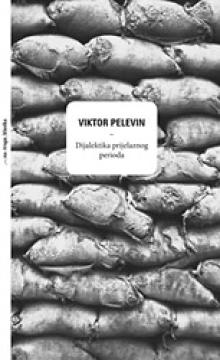
Dijalektika prijelaznog perioda

Dijalektika prijelaznog perioda

Viktor Pelevin

The book represents the author's anthology - the largest part is the novel Čisla (Čisla), followed by the short story Macedonian Criticism of French Thought and several short stories (Odin vog, Akiko, Fokus-grupa, Gost na prazniku bon).

At the heart of Chisla's novel is Stepa (Stepan), an oligarch of the new Russian capitalism of the 90s/2000s. He is obsessed with numbers: his "solar" number 34 (symbol of power, success) clashes with "lunar" 43 (symbol of ruin, Chubais and liberals). Stepa builds his life around the numerological cabal - he chooses numbers for phones, rooms, cars, lovers, jobs - believing that in this way he will control destiny. But the crisis of 1998 and the political turmoil shatter the illusion: the numbers turn against him, leading to paranoia, hallucinations and existential decline.

Pelevin mocks post-Soviet Russia: oligarchs, mafia, politics, Buddhism, New Age, capitalism and spirituality as commodities. Dialectic is a parody of Marxism – the transition from nowhere (Soviet nothingness) to nowhere (the new Russian chaos), where nothing changes, only repeats itself in new forms.

The stories are short, absurd, Buddhist-satirical: about virtual sex, Japanese culture, focus groups and "bon" (Buddhist holiday of the dead). The entire book is a cynical, witty critique of the transition – from communism to capitalism, from the material to the virtual, from nothingness to nothingness – with Pelevin's signature blend of philosophy, pop culture and dark humor.

Original title
Диалектика Переходного Периода из Ниоткуда в Никуда
Translation
Irena Lukšić
Illustrations
Stanko Abadžić
Dimensions
20 x 12.5 cm
Pages
316
Publisher
Disput, Zagreb, 2006.
 
Latin alphabet. Paperback.
Language: Croatian.

One copy is available

Condition:Used, excellent condition
 

Are you interested in another book? You can search the offer using our search engine or browse books by category.

You may also be interested in these titles

Đurđevak

Đurđevak

Prežihov Voranc

One of the most touching stories about childhood in the poor peasant world of Prekomurje. Through autobiographical elements, Voranc depicts the world of a boy who faces fear and love, emphasizing poverty and family ties.

Svjetlost, 1989.
Croatian. Latin alphabet. Hardcover.
2.48 - 3.98
Prvi kontakt

Prvi kontakt

Arthur C. Clarke

Zoran Živković, an excellent connoisseur of science fiction, made a selection of Clarke's best stories with the motif of first contact and wrote an extensive text in which he interprets them in detail.

NIRO Književne novine, 1985.
Serbian. Latin alphabet. Paperback.
5.64 - 5.72
Svetlosti Rima

Svetlosti Rima

Alberto Moravia

Through these stories, Moravia explores themes of social inequality, the struggle for survival, and human frailty, portraying them with a mix of humor, irony, and realistic observation.

Svjetlost, 1965.
Serbian. Latin alphabet. Paperback.
3.82 - 3.92
Stari nevjernik: Sabrana djela Branka Ćopića #6

Stari nevjernik: Sabrana djela Branka Ćopića #6

Branko Ćopić

Holy Donkey - People with Tails - Bitter Honey - Old Conversations

Prosveta, 1964.
Serbian. Latin alphabet. Hardcover.
3.52
Krčma na plovnom putu

Krčma na plovnom putu

Mladen Markov

Mladen Markov (1934–2013), a Serbian prose writer from Vojvodina known for his themes from rural life in Bačka, war traumas, and post-war destinies, published the collection Krčma na plovnom putu as a selection of short stories.

BIGZ, 1980.
Serbian. Latin alphabet. Paperback.
1.99 - 3.28
Lovčevi zapisi

Lovčevi zapisi

Ivan Sergejevič Turgenjev

A collection of short stories in which the author, in a poetic style, portrays man as the backbone of all events, and the beauty of Russia and the Russian soul in all its fullness.

Europapress holding, 2008.
Croatian. Latin alphabet. Hardcover.
4.22 - 4.28