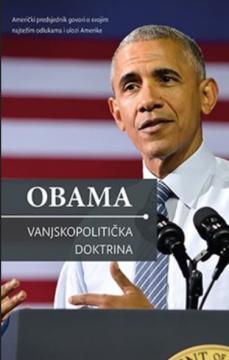
Obama – Vanjskopolitička doktrina
The American president talks about his toughest decisions about America's role in the world.
With the election of Donald Trump as president of the United States, there was probably the most dramatic turn in American foreign policy in the history of the world's only superpower - more dramatic than the turn in 2008 that occurred with Obama's election after eight years of George W. Bush. Everything that President Obama stated as the most important international achievements of his two terms has already collapsed or is about to collapse (the Trans-Pacific Partnership Agreement, the Paris Agreement on climate change, the agreement with Iran on nuclear weapons, the opening of relations with Cuba, the policy towards the Middle East, the fall of Aleppo, etc.). Still, a number of aspects of Goldberg's story are more fascinating than the fact that the foreign policy legacy of the Obama presidency will disappear even before Donald Trump's first day in office. From our Croatian and European perspective, it would be worth highlighting two things. First, Europe is obviously of third-rate importance in Obama's understanding of global politics. Another aspect of Obama's foreign policy doctrine that is worth highlighting from our perspective is his consistent focus on American national interests. What is particularly interesting is his fascination with the George H. W. Bush administration and, in particular, Bush's national security advisor Brent Scowcroft. While Obama's foreign policy doctrine can be described as a mixture of realism and internationalism, Trump's vision of America's role in the world is political realism on steroids - and political realism with extremely narrow and short-term defined American national interests. In such a constellation of forces, squeezed between two potential new partners in Washington and Moscow who share similar views on the world, Europe - and with it Croatia - is facing a fundamental turning point. Either we will find the strength and solve our own internal weaknesses and problems - or we will become a group of completely insignificant, atomized societies on the world stage, trapped in the atavisms of the first half of the twentieth century.
One copy is available