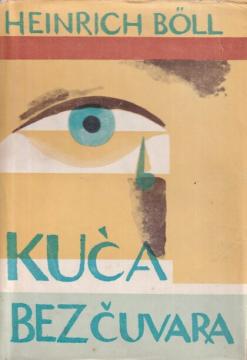
Kuća bez čuvara

Kuća bez čuvara

Heinrich Böll

The novel depicts the post-war period in Germany, and Böll, using the strange technique of painting the world from below through the mute mouth of a boy reporter, presents images of the spiritual and material rescue of the female protagonists of fatherles

The story takes place in post-war Germany and follows the lives of two families who lost their fathers in World War II. The focus is on the boys Heinrich (Heini) and Martin, who grow up without a father figure and try to understand the adult world. Through simple but powerful scenes, Böll depicts a generation marked by war. “The House Without a Guardian” symbolizes a society in which authority and security have disappeared, and children are forced to grow up too early.

Original title
Haus ohne huter
Translation
Mignon Mihaljević
Editor
Novak Simić
Dimensions
20.5 x 14.5 cm
Pages
266
Publisher
Zora, Zagreb, 1957.
 
Latin alphabet. Hardcover with dust jacket.
Language: Croatian.

One copy is available

Condition:Used, very good condition
Damages or inconvenience notice:
  • Traces of patina
  • The cover is missing
 

Are you interested in another book? You can search the offer using our search engine or browse books by category.

You may also be interested in these titles

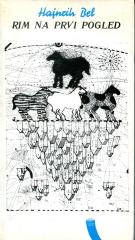
Rim na prvi pogled

Rim na prvi pogled

Heinrich Böll
Književne novine, 1989.
Serbian. Latin alphabet. Paperback.
9.997.99
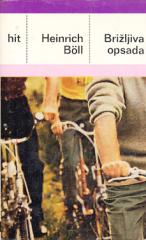
Brižljiva opsada

Brižljiva opsada

Heinrich Böll
Znanje, 1981.
Croatian. Latin alphabet. Hardcover with dust jacket.
5.96 - 6.88
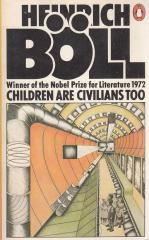
Children Are Civilians Too

Children Are Civilians Too

Heinrich Böll

These twenty-six stories illustrate Heinrich Boll's finely nuanced storytelling at its best. In stunning portraits of ordinary people, Boll creates a rich tapestry of the dark years in postwar Germany.

Penguin Books Ltd, 1976.
English. Latin alphabet. Paperback.
11.70
Proces

Proces

Franz Kafka

Kafka wrote The Process between 1914 and 1915, published posthumously in 1925. The novel is unfinished but with an added final chapter by Max Brod. Edition with a foreword by B. Živojinović and an afterword by Walter Killi.

BIGZ, 1990.
Serbian. Latin alphabet. Paperback.
4.26
Usta puna zemlje

Usta puna zemlje

Branimir Šćepanović

The novel "Usta puna zemlje" (1970), the masterpiece of the Serbian writer Branimir Šćepanović, is a psychologically in-depth explorer of the limits of the human soul, solitude and existential freedom, reminiscent of Kafka and Camus.

BIGZ, 1987.
Serbian. Latin alphabet. Paperback.
3.98
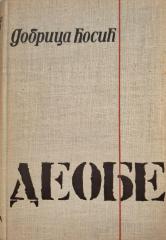
Deobe

Deobe

Dobrica Ćosić

Deobe is a novel about the tragic division of Serbs into Chetniks and Partisans during World War II. Winner of the NIN Award, it is part of a wider epic trilogy, inspired by Ćosić's experiences and historical documents.

Prosveta, 1963.
Croatian. Latin alphabet. Hardcover with dust jacket.
13.74