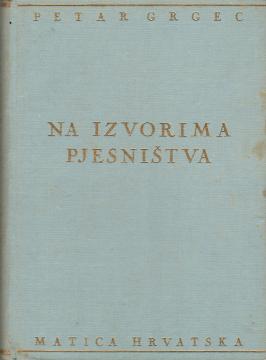
Na izvorima pjesništva
Antique

Na izvorima pjesništva

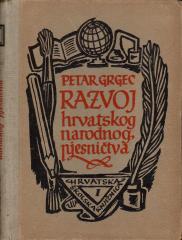
Petar Grgec

The book systematically explores the fundamental spiritual, cultural, and aesthetic sources of poetry. Through consideration of motifs, tradition, language, religion, and worldview, Grgec shows how poetic expression and experience are shaped.

On the Sources of Poetry by Petar Grgec is a broadly conceived work that seeks to explain the deep roots and inner drivers of poetic creation. The author begins by elaborating on the poet's way of creating, reflecting on how inspiration is transformed into a formed word. This is followed by an analysis of the cultural strands of poetic expression, where Grgec shows that poetry never appears in a vacuum, but in dialogue with tradition, language and spiritual heritage.

A special section is dedicated to the development of poetic knowledge, i.e. the question of how a poet is shaped through learning, experience and encounter with literary heritage. Grgec then explores folk and ancient sources, comparing the motifs and techniques of Homeric poetry with Croatian folk tradition and emphasizing their role in forming the European lyrical horizon. He also analyzes biblical texts, especially Song of Songs, highlighting the strong symbolism and spiritual depth that have inspired poets for centuries.

In the chapters on the relationship between poetry and life, the author considers how personal reality, work, and social circumstances shape the poet's voice. He develops the idea that poetic creation is not an escape from the world, but its deepened reflection. He also speaks of dream, as a particularly fertile space for poetic imagination, and of the moment of poetic experience, that brief flash of inspiration from which a poem emerges.

A significant part of the book is devoted to issues of literature and worldview, nationality, and the value and symbolic power of works such as Mihanović's "Croatian Homeland". In the appendix, Grgec analyzes folk songs as an inexhaustible source of motifs, rhythms, and lyrical sensibility.

The work is thoughtful, rich in insights, and written in a clear and humanistic style, which is why it represents a valuable guide through the spiritual sources and inner dynamics of poetry.

Dimensions
21 x 16 cm
Pages
176
Publisher
Matica hrvatska, Zagreb, 1940.
 
Latin alphabet. Hardcover.
Language: Croatian.

One copy is available

Condition:Used, excellent condition
 

Are you interested in another book? You can search the offer using our search engine or browse books by category.

You may also be interested in these titles

I drugi su pjevali o ratu: Odjeci raspada Jugoslavije u engleskoj i američkoj književnosti

I drugi su pjevali o ratu: Odjeci raspada Jugoslavije u engleskoj i američkoj književnosti

Muharem Bazdulj

In this book of essays, Muharem Bazdulj analyzes how the collapse of Yugoslavia and the wars of the 1990s resonated in Anglo-Saxon literature – from pre-war stereotypes to war and post-war depictions.

Biblioteka XX vek, 2013.
Croatian. Latin alphabet. Paperback.
8.24
Katastrofe

Katastrofe

Books and writers mark catastrophes on the map, catastrophes of the wars of the nineties, catastrophes of the Holocaust, catastrophes as words from the street and television, traffic that is a catastrophe, the price of carrots that is a catastrophe, catas

MeandarMedia, 2024.
Croatian. Latin alphabet. Paperback with dust jacket.
17.98
Pisma iz progonstva / Zimske beleške o letnjim utiscima / Krotka

Pisma iz progonstva / Zimske beleške o letnjim utiscima / Krotka

Fjodor Mihajlovič Dostojevski

Fyodor Dostoevsky, one of the greatest writers and visionaries in history, is presented in this edition with a selection from his correspondence (Letters from Exile), an account of his first trip to Europe (Winter Notes on Summer Impressions), and the fam

LOM, 2012.
Serbian. Cyrillic alphabet. Paperback.
6.74
Bosna sjete i zaborava

Bosna sjete i zaborava

Enes Karić

Essays about the land of inexhaustible inspirations.

Durieux, 1997.
Croatian. Latin alphabet. Paperback.
5.32
Dnevnici, 1. svezak: 1909-1912.

Dnevnici, 1. svezak: 1909-1912.

Franz Kafka

Kafka's diaries, published posthumously, reveal the inner world of an anxious genius. The first volume covers his early years, when Kafka worked as an insurance clerk in Prague, faced with a dreary life and literary ambitions.

Tim press, 2022.
Croatian. Latin alphabet. Paperback.
15.42
Kad ste utopljeni u plamenu

Kad ste utopljeni u plamenu

David Sedaris

If it seems to you that beneath the surface of the sometimes monotonous everyday life lies a hilarious absurdity, David Sedaris will finally convince you of that.

Algoritam, 2010.
Croatian. Latin alphabet. Paperback.
3.98