Spectrum III: A Third Science Fiction Anthology
Rare book

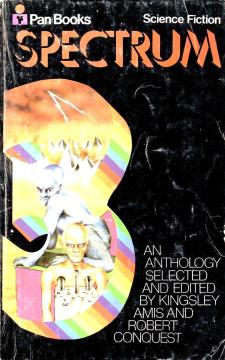
Spectrum III: A Third Science Fiction Anthology

Theodore Sturgeon, James Graham Ballard, Poul Anderson, Mark Rose, Peter Phillips, Murray Leinster, Alfred Bester, Arthur C. Clarke

Spectrum III is an anthology of classic science fiction edited by Kingsley Amis and Robert Conquest. It brings together iconic stories from renowned authors about space, time, man, and the future.

Spectrum III: A Third Science Fiction Anthology is the third sequel to the famous science fiction anthology edited by Kingsley Amis and Robert Conquest. The book presents a selection of representative stories by authors who marked the golden age and development of modern SF literature. Among them are *Theodore Sturgeon, J. G. Ballard, Poul Anderson, Murray Leinster, Alfred Bester and Arthur C. Clarke, whose famous story The Sentinel served as inspiration for the later novel and film 2001: A Space Odyssey.

The collection covers various subgenres of science fiction – from space exploration and encounters with unknown life forms to psychological, philosophical and social themes. Stories like Killdozer!, Call Me Joe, The Voices of Time and Exploration Team explore the limits of human endurance, technology, evolution and man's relationship to the unknown. Thanks to its diverse selection of authors and styles, the anthology provides an excellent overview of the development of SF during the mid-20th century.

This edition from Pan Books of London is a valuable example of classic science fiction literature and is of interest to both collectors and readers who want to get to know the most influential authors and stories of the genre.

Editor
Kingsley Amis, Robert Conquest
Dimensions
18 x 11 cm
Pages
287
Publisher
Pan Books, London, 1971.
 
Latin alphabet. Paperback.
Language: English.

One copy is available

Condition:Used, excellent condition
 

Are you interested in another book? You can search the offer using our search engine or browse books by category.

You may also be interested in these titles

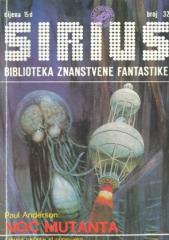
Sirius #32: Biblioteka znanstvene fantastike

Sirius #32: Biblioteka znanstvene fantastike

Paul Anderson, Isaac Asimov, Dmitrij Despiller, Phillip Latham, Philip K. Dick, Mack Reynolds, Fr...

Sirius was a Croatian science fiction magazine. The foundation was proposed by Damir Mikuličić in 1976. In Sirius, the works of domestic authors, as well as translations of foreign SF authors, were published. It was published from 1976 to 1989.

Vjesnik, 1979.
Croatian. Latin alphabet. Paperback.
2.50
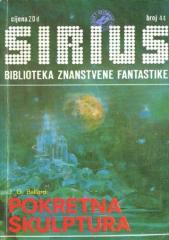
Sirius #44: Biblioteka znanstvene fantastike

Sirius #44: Biblioteka znanstvene fantastike

J. G. Ballard, Tatjana Vranić, Ray Bradbury, István Szomohazi, Mauro Antonio Miglieruolo, Bertil ...

Sirius was a Croatian science fiction magazine. The foundation was proposed by Damir Mikuličić in 1976. In Sirius, the works of domestic authors, as well as translations of foreign SF authors, were published. It was published from 1976 to 1989.

Vjesnik, 1980.
Croatian. Latin alphabet. Paperback.
2.00
Posljednji dani ljudi

Posljednji dani ljudi

Camille Flammarion

The second part of Flammarion's popular science work The Doom of the World (1894.). A speculative account of life on Earth in ten million years and the gradual end of humanity. Popular science with elements of science fiction.

Hrvatsko prirodoslovno društvo, 1920.
Croatian. Latin alphabet. Paperback.
12.34
Dva neba 6.dio

Dva neba 6.dio

Chris Wooding

The Parakkans are fighting fiercely. Aurin has increased patrols. The captured Ryushi has privileges not granted to a prisoner about to be executed. Corm is furious.

Grlica, 2003.
Croatian. Latin alphabet. Hardcover.
5.32
Prva žena na Marsu

Prva žena na Marsu

John Beynon

The First Woman on Mars is, from the current point of view, a novel with a somewhat naive plot about a human journey to Mars. Against the backdrop of this plot, the author examines the relationship between humans and machines.

Kosmos, 1954.
Serbian. Latin alphabet. Paperback.
3.85
Obračun s dr. Dongom

Obračun s dr. Dongom

Josef Nesvadba

The motif that Nesvadba has already used in a science fiction context, the FALSIFICATION OF AN ARCHAEOLOGICAL FIND, in "The Showdown with Doctor Dong" serves as a starting point for questioning the RELATIONSHIP BETWEEN REVOLUTION AND SCIENTIFIC TRUTH.

Epoha, 1965.
Croatian. Latin alphabet. Hardcover with dust jacket.
4.25