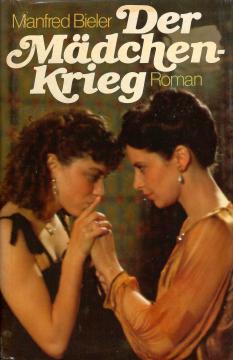
Der Mädchenkrieg

Der Mädchenkrieg

Manfred Bieler

An epic saga of three sisters in Prague during the 1930s and World War II. Through their destinies, Bieler depicts political turmoil, Nazi occupation, love, survival, and the decline of a society.

Der Mädchenkrieg is one of the most famous works by German writer Manfred Bieler. This extensive historical and family novel follows the fate of the Pasetti family — more precisely, the three sisters Christine, Sophie and Katharina — in a dramatic period of Czechoslovak history from the mid-1930s until the end of World War II.

The plot is set in Prague, a city of rich culture and turbulent geopolitics. Through the growth and maturation of three sisters with completely different personalities, the author masterfully intertwines their personal passions, love affairs and family conflicts with major historical turning points. The rise of Nazism, the collapse of Czechoslovakia, the German occupation and finally the arrival of the Red Army irreparably change their lives and force them to make difficult moral and life compromises.

With great narrative power and a dose of humorous, yet tragicomic realism, Bieler depicts the atmosphere of Central Europe on the eve of and during the war. The novel's title alludes to an old Czech legend of a women's rebellion, but in this context it symbolizes the inner strength and struggle of women for survival in a world dominated by male wars and destructive ideologies. The work is a layered portrait of an era, a deeply moving story of loyalty, betrayal and the indomitability of the human spirit.

Dimensions
22 x 14 cm
Pages
591
Publisher
Hoffmann und Campe Verlag, Hamburg, 1975.
 
Latin alphabet. Hardcover with dust jacket.
Language: German.

One copy is available

Condition:Used, excellent condition
 

Are you interested in another book? You can search the offer using our search engine or browse books by category.

You may also be interested in these titles

Noć

Noć

Edgar Hilsenrath

A poignant novel describing life in a Jewish ghetto in Ukraine, based on the author's experience as a Holocaust survivor. Set in the fictional town of Prokov, the novel follows the inhabitants of the ghetto, especially Raneko, as they struggle to survive.

August Cesarec, 1982.
Croatian. Latin alphabet. Hardcover with dust jacket.
6.58
Gedichte über die Liebe

Gedichte über die Liebe

Bertolt Brecht
Suhrkamp Verlag, 1984.
German. Latin alphabet. Paperback.
4.24
Jadi mladoga Vertera

Jadi mladoga Vertera

Goethe's masterpiece of an epistolary novel from 1774 (revised in 1787), pivotal to the Sturm und Drang movement, caused a cultural upheaval in Europe – a wave of suicides, "Wertherism" and the imitation of heroes in fashion and sentiment.

Nolit, 1966.
Serbian. Latin alphabet. Hardcover.
4.88
Kriv je ubijeni ne ubica

Kriv je ubijeni ne ubica

Franz Werfel
Beogradski grafičko-izdavački zavod, 1975.
Serbian. Latin alphabet. Paperback.
2.86
Poezija i zbilja

Poezija i zbilja

Johann Wolfgang Goethe

Goethe's greatest autobiographical prose, written between 1811 and 1833, covers his life from his birth in 1749 in Frankfurt to 1775, when he went to Weimar at the invitation of Duke Karl August.

Matica hrvatska, 1953.
Croatian. Latin alphabet. Hardcover with dust jacket.
18.42
Iz života jedne dangube

Iz života jedne dangube

Joseph Eichendorff
Zora, 1951.
Croatian. Latin alphabet. Paperback.
3.98