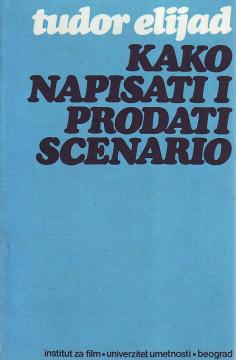
Kako napisati i prodati scenario

Kako napisati i prodati scenario

Tudor Elijad

Tudor Eliad’s 1982 practical handbook provides detailed guidelines on the structure, dramatic elements, and writing of a screenplay, as well as the professional steps for its successful sale and production.

"How to Write and Sell a Screenplay" (1982) is a manual by screenwriter and filmmaker Tudor Eliad, designed as a comprehensive and practical guide to the theory and practice of screenwriting. The book is intended for beginners and film students alike, as well as for more experienced writers wishing to hone their dramaturgical skills and understand the mechanics of the film industry. In the book, Eliad breaks down every stage of screenplay development in detail—from the initial idea, synopsis, sequencing, and character development to the writing of the full script (spec script) and dialogue. The author emphasizes the importance of visual storytelling, pacing, internal and external conflict, and adherence to standard rules of structure and formatting—prerequisites for professional acceptance by production companies. The second part of the title, dealing with "selling" the screenplay, offers valuable, pragmatic advice on pitching one's work, establishing contacts with producers and directors, and navigating the professional landscape. The writing style is clear and instructive, supported by examples, making this work a pioneering and timeless guide for anyone aspiring to succeed in the field of film and television writing.

Original title
Comment ecrire et vendre son scenario
Translation
Gordana Velmar, Borivoj Kaćura
Editor
Predrag Golubović
Dimensions
20 x 13 cm
Pages
143
Publisher
Institut za film, Beograd, 1982.
 
Distribution: 2,000 copies
 
Latin alphabet. Paperback.
Language: Serbian.

One copy is available

Condition:Used, excellent condition
 

Are you interested in another book? You can search the offer using our search engine or browse books by category.

You may also be interested in these titles

Film, mit i stvarnost #2 Brižit Bardo

Film, mit i stvarnost #2 Brižit Bardo

Duga, 1965.
Croatian. Latin alphabet. Paperback.
4.22
Jesen 4000 neto

Jesen 4000 neto

Puriša Đorđević
Institut za film, 2002.
Serbian. Latin alphabet. Paperback.
8.24
Izgubljeni svetovi srpskog filma fantastike / The Lost Worlds of Serbian Fantastic Cinema

Izgubljeni svetovi srpskog filma fantastike / The Lost Worlds of Serbian Fantastic Cinema

Jovan Ristić, Dragan Jovičević
Filmski centar Srbije, 2014.
Serbian. Latin alphabet. Paperback.
12.74
Otvorena knjiga

Otvorena knjiga

John Huston
Institut za film, 1990.
Serbian. Latin alphabet. Paperback.
11.32
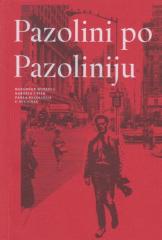
Pazolini po Pazoliniju: razgovor Đuzepea Kardila i Pjer Paola Pazolinija u Njujorku

Pazolini po Pazoliniju: razgovor Đuzepea Kardila i Pjer Paola Pazolinija u Njujorku

Pier Paolo Pasolini, Giuseppe Cardillo

In one of the last interviews, from 1969, Giuseppe Cardillo talks to Pier Paolo Pasolini, director of cult films such as Salo or 120 days of Sodom and Decameron, writer, poet and one of the most important intellectuals of Italy in the 20th century

Multimedijalni institut, 2023.
Serbian. Latin alphabet. Paperback.
7.54
Kako što nastaje: novine, film, teatar

Kako što nastaje: novine, film, teatar

Karel Čapek

In a witty and instructive essay, Čapek describes how a newspaper, a film, and a theater play are created. Through humor and irony, he shows the complexity of the process – from idea to realization – and the different perspectives of the participants, dem

Znanje, 1985.
Croatian. Latin alphabet. Paperback.
4.76