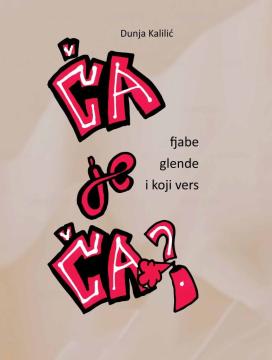
Ča je ča? fjabe, glende i koji vers

Ča je ča? fjabe, glende i koji vers

Dunja Kalilić

Dunja Kalilić’s poetry collection, written in the Split *Čakavian* dialect, presents gentle and melancholic verses dedicated to the sea, Dalmatia, tradition, and the Mediterranean mentality, all through the motif of a distinctive interrogative pronoun.

The poetry collection Ča je ča (2024) by Dunja Kalilić—a writer from Split and Dalmatia—represents a valuable contribution to contemporary Croatian Čakavian poetry. With a title that highlights authentic Čakavian expression, the author draws directly upon the rich tradition of Dalmatian dialect poetry in this mature work. Dunja Kalilić’s poetic language is distinguished by its musicality, vivid imagery, and a keen sense of the local speech's rhythm. Through thematically diverse verses, the collection encompasses a wide range of motifs: from nostalgia for times past and old customs of Split and Dalmatia to intimate Mediterranean landscapes, the sea, the sun, narrow alleyways, and solitude. The motif of questioning and the search for meaning ("ča je ča" / "what is what") permeates the entire work, offering the reader a reflective insight into the transience and beauty of life. This work serves not only as a poetic homage to the author's homeland and identity but also as a significant linguistic and cultural contribution to the preservation and appreciation of the Čakavian dialect. The book is intended for admirers of Dalmatian lyric poetry, enthusiasts of the Čakavian dialect, and anyone who enjoys an authentic Mediterranean atmosphere captured in verse.

Editor
Anita Runjić Stoilova
Graphics design
Luka Kalilić
Dimensions
22 x 15 cm
Pages
175
Publisher
Marko Marulić, Split, 2024.
 
Latin alphabet. Hardcover.
Language: Croatian.

One copy is available

Condition:Unused
 

Are you interested in another book? You can search the offer using our search engine or browse books by category.

You may also be interested in these titles

Crni zec (sabrane i nove pjesme)

Crni zec (sabrane i nove pjesme)

Drago Glamuzina

The title poem, "The Black Rabbit," represents a kind of symbolist maneuver within "real" poetry, because like Baudelaire's "Albatross," it possesses a pronounced unambiguous charge.

Vuković & Runjić, 2022.
Croatian. Latin alphabet. Paperback.
8.56 - 9.98 €
88

88

Nadija Rebronja

A piano usually has 88 keys, 52 white and 36 black, from which 88 tones emerge. A pianist usually reads 88 notes. These 88 micro-proses simultaneously constitute one piano and one piano concerto.

Buybook, 2022.
Croatian. Latin alphabet. Paperback.
5.944.16 €
Rasuta sonetna ostrva

Rasuta sonetna ostrva

Hadžem Hajdarević

The book is designed as a series of "islands" - individual poems that function independently, but complement each other, forming a thematic whole.

Planjax, 2019.
Croatian. Latin alphabet. Hardcover.
9.84 €
Metamorfoze iliti pretvorbe

Metamorfoze iliti pretvorbe

Mario Kovač

The main motifs of the collection are love and everyday life, followed by poetry, and a subtle homage to Zagreb.

Što čitaš?, 2019.
Croatian. Latin alphabet. Paperback.
5.38 €
Krvava knjiga

Krvava knjiga

Franjo Nagulov

Franjo Nagulov's new poetry collection, The Bloody Book, is a dark record of the decline of a society.

Durieux, 2024.
Croatian. Latin alphabet. Paperback.
8.555.99 - 8.96 €
Slika i zvuk suvremene poezije

Slika i zvuk suvremene poezije

Željko Grbac, Slavko Mihalić

11th Yugoslav Poetry Festival - Rijeka - 31.5 to 5.6. 1958.

Lykos, 1958.
Croatian. Latin alphabet. Paperback.
6.98 €