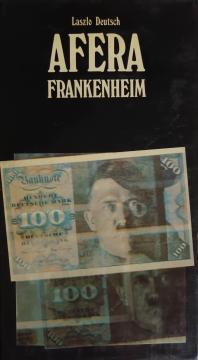
The Frankenheim Affair should acquaint the reader with the way in which the Hitlerian machinery was used for its financial manipulations, how it used a real Jewish bank as a cover for its operations during and after the Second World War.
Original title
L' affaire Frankenheim
Translation
Ladislav Grakalić
Graphics design
Hinko Bohr
Dimensions
22.5 x 12.5 cm
Pages
267
Publisher
Centar za informacije i publicitet (CIP), Zagreb, 1981.
In the book, Joan Solé shows the life, ideology and rise of Adolf Hitler. The book explores how a charismatic but fanatical leader shaped a totalitarian regime and plunged the world into one of the most tragic wars in history.
Twins Company d.o.o., 2025.
Croatian. Latin alphabet. Paperback.
8.56 €
Militaria • World War II • Military history
Jews in Yugoslavia 1944–1952 by Mladenka Ivanković depicts the renewal of the life of the Jewish community after the Holocaust, its relationship with the new authorities, and emigration to Israel and the preservation of identity.
Institut za noviju istoriju Srbije, 2009.
Serbian. Latin alphabet. Hardcover.
36.42 €
Documents and records • World War II • Croatian history • History of the church • Political-historical essays
A sociological-historical study in which Ivan Cvitković analyzes the activities of the Archbishop of Zagreb in the context of the Independent State of Croatia, World War II and the post-war period, relying on sources available at the time.
NIŠRO Oslobođenje, 1986.
Croatian. Latin alphabet. Hardcover with dust jacket.
11.62 €
World War II • Military history • 20th Century
The Battle of Moscow is a historical account of the German Operation "Barbarossa", the Soviet defense and counteroffensive in 1941. The author, with the testimonies of the top Soviet military leaders, shows how the first German defeat in the war unfolded.
Alfa, 1975.
Croatian. Latin alphabet. Hardcover with dust jacket.
7.96 €
World War II • Croatian history • Yugoslavia • Serbian History • Political-historical essays
The generation to which Konstantinović belonged managed to reach an agreement and, had it not been for the Second World War, was on the threshold of establishing liberal democracy in Yugoslavia, whose supporter Konstantinović was.