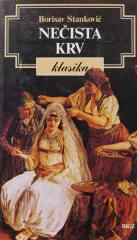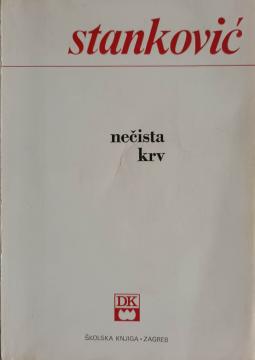
Nečista krv

Nečista krv

Borisav Stanković

In Vranje at the end of the 19th century, Sofka, a beautiful girl from a respectable but ruined family, carries the "impure blood" of gypsy origin. Her beauty and passion attract men, but fate is merciless: a marriage of convenience, violence, madness and

Impurity Blood by Boro Stanković (1899/1902) is a masterpiece of Serbian and South Slavic literature, the most powerful depiction of Balkan petty-bourgeois society, passions, prejudices and the fate of an individual trapped in his heritage and environment.

The plot takes place in Vranje, a small town in southern Serbia, during the Turkish rule and the beginning of modernization. The main heroine is Sofka, an exceptionally beautiful girl from the once wealthy and respectable Hadži Trifunović family. Her grandfather was a respectable merchant, but the family has fallen into ruin, and the biggest secret is that Sofka's grandmother has gypsy origins – "impure blood" that is not forgiven in a small town.

Sofka's beauty becomes a curse: everyone wants her, but no one appreciates her as a person. Her father marries her off to a rich but old and violent merchant Mitket in order to save the family from misery. The marriage is a disaster – violence, humiliation, Sofka's passion for another man (Tomča), jealousy, scandal. Sofka struggles between pride, desire for freedom, and fear of a society that condemns her.

The novel culminates in a tragic breakdown: Sofka sinks into madness, the family is destroyed, and “impure blood” becomes a metaphor for a fate that cannot be escaped – inheritance, social prejudice, Balkan fatalism, and the impossibility of individual happiness in a narrow, patriarchal world.

Editor
Branko Hećimović
Graphics design
Jelena Musić
Dimensions
20 x 14 cm
Pages
171
Publisher
Školska knjiga, Zagreb, 1974.
 
Latin alphabet. Paperback.
Language: Croatian.

Multiple copies are available

Copy number 1

Condition:Used, excellent condition

Copy number 2

Condition:Used, excellent condition

Copy number 3

Condition:Used, excellent condition
 

Are you interested in another book? You can search the offer using our search engine or browse books by category.

You may also be interested in these titles

Nečista krv

Nečista krv

Borisav Stanković
Veselin Masleša, 1987.
Croatian. Latin alphabet. Hardcover.
2.99
Nečista krv

Nečista krv

Borisav Stanković

"Impure Blood" (1910), Borisav Stanković's masterpiece, is a psychological novel that explores the themes of tradition, passion, social norms and the tragic fate of the individual in the patriarchal society of southern Serbia.

BIGZ, 1987.
Serbian. Latin alphabet. Paperback.
4.24 - 4.88
Tri mušketira 1-2

Tri mušketira 1-2

Alexandre Dumas

Dumas' version of the story depicts the adventures of d'Artagnan and his friends from 1625 to 1628.

Epoha, 1966.
Croatian. Latin alphabet. Hardcover with dust jacket.
The book consists of two volumes
9.48
Proces

Proces

Franz Kafka

Kafka wrote The Process between 1914 and 1915, published posthumously in 1925. The novel is unfinished but with an added final chapter by Max Brod. Edition with a foreword by B. Živojinović and an afterword by Walter Killi.

BIGZ, 1990.
Serbian. Latin alphabet. Paperback.
4.26
Zagrepčanka

Zagrepčanka

Branislav Glumac

Branislav Glumac published a novel without periods or commas in 1974, as the relentless stream of thought of a young rebel. Published in socialist Yugoslavia, the work caused a scandal with its openness and became a classic about generational rebellion.

IROS, 1986.
Croatian. Latin alphabet. Hardcover.
8.24
Usta puna zemlje

Usta puna zemlje

Branimir Šćepanović

The novel "Usta puna zemlje" (1970), the masterpiece of the Serbian writer Branimir Šćepanović, is a psychologically in-depth explorer of the limits of the human soul, solitude and existential freedom, reminiscent of Kafka and Camus.

BIGZ, 1987.
Serbian. Latin alphabet. Paperback.
3.98