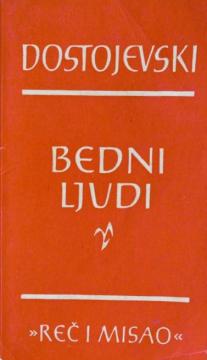

Bedni ljudi

Bedni ljudi

Fjodor Mihajlovič Dostojevski

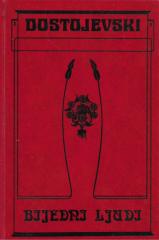
Miserable people is the first book of the Russian writer Fyodor Dostoyevsky, which he wrote over nine months. The book was first published in 1846

Original title
Бедные люди
Translation
Radivoj J. Maksimović
Dimensions
19 x 11 cm
Pages
154
Publisher
Rad, Beograd, 1962.
 
Latin alphabet. Paperback.
Language: Serbian.

No copies available

The last copy was sold recently.

 

Are you interested in another book? You can search the offer using our search engine or browse books by category.

You may also be interested in these titles

Ujakov san / Poniženi i uvrijeđeni

Ujakov san / Poniženi i uvrijeđeni

Fjodor Mihajlovič Dostojevski

Both works reflect Dostoevsky's early phase, with a focus on social criticism, psychological analysis and moral dilemmas, foreshadowing the themes of his later masterpieces.

Znanje, 1982.
Croatian. Latin alphabet. Hardcover.
13.249.93 - 13.26
Svinjarija / Krokodil / Kockar / Vječiti muž

Svinjarija / Krokodil / Kockar / Vječiti muž

Fjodor Mihajlovič Dostojevski

All the works published in this volume reflect Dostoevsky's ability to expose human frailties, social flaws and moral dilemmas through humor, satire and psychological depth, often with universal themes that still resonate today.

Znanje, 1982.
Croatian. Latin alphabet. Hardcover.
14.75
Zapisi iz mrtvog doma / Zimske bilješke o ljetnim dojmovima / Zapisi iz podzemlja

Zapisi iz mrtvog doma / Zimske bilješke o ljetnim dojmovima / Zapisi iz podzemlja

Fjodor Mihajlovič Dostojevski

Notes from a Dead Home (1860-1862) - a novel based on the author's imprisonment in Siberia. Winter Notes on Summer Impressions (1863) - an essay from a trip to Europe in 1862. Notes from the Underworld (1864) is a philosophical novel about a man torn by i

Znanje, 1982.
Croatian. Latin alphabet. Hardcover.
16.53
Usta puna zemlje

Usta puna zemlje

Branimir Šćepanović

The novel "Usta puna zemlje" (1970), the masterpiece of the Serbian writer Branimir Šćepanović, is a psychologically in-depth explorer of the limits of the human soul, solitude and existential freedom, reminiscent of Kafka and Camus.

BIGZ, 1987.
Serbian. Latin alphabet. Paperback.
3.98
Deobe 1-3

Deobe 1-3

Dobrica Ćosić

This work, awarded the NIN Prize for that year, is considered one of the most significant in Serbian literature after World War II.

Prosveta, 1961.
Serbian. Cyrillic alphabet. Hardcover with dust jacket.
The book consists of 3 volumes
11.42
Zagrepčanka

Zagrepčanka

Branislav Glumac

Branislav Glumac published a novel without periods or commas in 1974, as the relentless stream of thought of a young rebel. Published in socialist Yugoslavia, the work caused a scandal with its openness and became a classic about generational rebellion.

IROS, 1986.
Croatian. Latin alphabet. Hardcover.
8.24