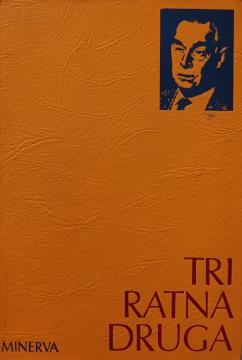

Tri ratna druga

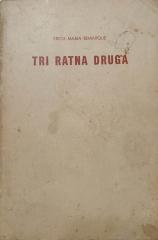
Tri ratna druga

Erich Maria Remarque

Three World War I comrades—Robbie, Otto, and Gottfried—try to survive in Weimar Germany in 1928. Amid economic crisis, poverty, and political violence, their friendship is their only refuge.

Three Comrades in Arms (1936) is a novel by Erich Maria Remarque about friendship, love and the struggle for dignity in the turbulent Weimar Republic.

The story takes place in 1928–1929 in Germany, which is gripped by a major economic crisis, unemployment and growing political extremism. The main characters are three former soldiers: Robert Lohkamp (Robbie), Otto Köster and Gottfried Lenz. Together they run a small car repair shop, drive the legendary car “Karl” and try to preserve humanity in a world that is falling apart.

Their unbreakable friendship is the only solid point in the chaos of poverty and street violence. The story takes on a new dimension when Robbie falls in love with Patricia Holman (Pat), a classy girl suffering from tuberculosis.

Remarque masterfully depicts the everyday life of ordinary people – small joys, losses, humor and melancholy. The novel is a moving ode to male friendship and love at a time when these values ​​were most threatened.

The book was banned in Nazi Germany. One of Remarque's most emotional works after All Is New in the West.

Original title
Drei kameraden
Translation
Kaćuša Avakumović Maletin
Dimensions
20 x 14.5 cm
Pages
448
Publisher
Minerva, Subotica, 1978.
 
Latin alphabet. Hardcover.
Language: Serbian.

Two copies are available

Copy number 1

Condition:Used, excellent condition

Copy number 2

Condition:Used, good condition (visible signs of use)
Damages or inconvenience notice:
  • Damaged covers
 

Are you interested in another book? You can search the offer using our search engine or browse books by category.

You may also be interested in these titles

Tri ratna druga

Tri ratna druga

Erich Maria Remarque

Three World War I comrades—Robbie, Otto, and Gottfried—try to survive in Weimar Germany in 1928. Amid economic crisis, poverty, and political violence, their friendship is their only refuge.

Minerva, 1953.
Serbian. Latin alphabet. Paperback.
1.99
Povratak

Povratak

Erich Maria Remarque
Minerva, 1955.
Croatian. Latin alphabet. Hardcover.
1.62 - 1.98
Zmija oko vrata I-II

Zmija oko vrata I-II

Lydia Scheuermann-Hodak

War-psychological prose set during the Homeland War (1991–1995), with a focus on Slavonia and partly on events in Bosnia. The work belongs to a cycle of prose about the war and women's experiences in it.

Grafika, 2004.
Croatian. Latin alphabet. Paperback.
The book consists of two volumes
9.76
Ranjeni pejzaž

Ranjeni pejzaž

Vladimir Mičetić

A book by Vladimir Mičetić, a doctor and volunteer of the Homeland War from Kutina. The work was awarded the literary prize "We Were the First When It Was Necessary" for 2010, awarded by the Association of Croatian Homeland War Veterans.

Spiritus Movens, 2010.
Croatian. Latin alphabet. Hardcover.
11.52
Sarajevski Marlboro / Karivani / Druge priče, 1992–1996

Sarajevski Marlboro / Karivani / Druge priče, 1992–1996

Miljenko Jergović

Along with the reissues of "Sarajevo Marlboro" and "Karivan", the book also contains a new cycle of stories by this author. These stories vividly portray characters, "little" people, witnesses of "big" history, and seemingly insignificant, but for them pi

Durieux, 1999.
Croatian. Latin alphabet. Paperback.
14.72
Baraka Pet Be i druge novele

Baraka Pet Be i druge novele

Miroslav Krleža

The collection "Baraka Pet Be i druge novele" brings a selection of Krleža's anti-war novels from the period 1916–1920s, focusing on the senselessness of World War I, the suffering of the Home Guard and the downfall of Austria-Hungary.

Mladost, 1987.
Croatian. Latin alphabet. Hardcover.
5.38