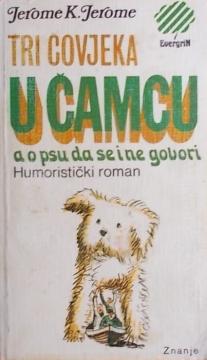
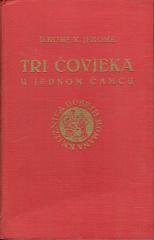
Tri čovjeka u čamcu - a o psu da se i ne govori

Tri čovjeka u čamcu - a o psu da se i ne govori

Jerome K. Jerome
Translation
Nikola Kršić
Editor
Zlatko Crnković
Graphics design
Alfred Pal
Dimensions
19.5 x 12 cm
Pages
210
Publisher
Znanje, Zagreb, 1980.
 
Latin alphabet. Paperback.
Language: Croatian.

No copies available

The last copy was sold recently.
 

Are you interested in another book? You can search the offer using our search engine or browse books by category.

You may also be interested in these titles

12 stolica

12 stolica

Ilja Iljf, Jevgenij Petrov

A satirical search for hidden treasure in post-revolutionary Russia. Former nobleman Ippolit Matveyevich Vorobyaninov and con artist Ostap Bender chase after valuables, exposing the greed and absurdities of Soviet society.

Šareni dućan, 2013.
Croatian. Latin alphabet. Hardcover.
16.54
Who's Who in Hell

Who's Who in Hell

Robert Chalmers

"Who's Who in Hell" (2002) is the debut novel by British journalist and author Robert Chalmers, a comic, provocative and emotional story about love, loss and the absurdities of life.

Atlantic Books, 2003.
English. Latin alphabet. Paperback.
6.74
Gargantua i Pantagruel

Gargantua i Pantagruel

François Rabelais

Rabelais' masterpiece, a five-book novel cycle that follows the adventures of the giant Gargantua and his son Pantagruel. Vinaver, known for his linguistic virtuosity, masterfully conveys Rabelais's lavish humor, juicy swear words, and layered wordplay.

Kultura, 1950.
Serbian. Cyrillic alphabet. Hardcover.
The book consists of two volumes
11.34
Pokondirena tikva

Pokondirena tikva

Jovan Sterija Popović

In the comedy Pokondirena tikva, the main character Fema, an ordinary citizen obsessed with the upper class, comically tries to play the role of a lady. The play mocks snobbery, hypocrisy, and the desire for someone else's appearance and manners.

Mladost, 1987.
Serbian. Latin alphabet. Paperback.
6.54
Zlatno tele

Zlatno tele

Ilja Iljf, Jevgenij Petrov

The Golden Calf (1931) is a brilliant satirical picaresque adventure, a sequel to the legendary 12 Chairs, where the great schemer Ostap Bender returns in full glory – charming, cynical, irredeemably cunning and always one step ahead of everyone else.

Kultura, 1946.
Croatian. Latin alphabet. Hardcover with dust jacket.
7.56
Figarova ženidba ili Ludi dan: Komedija u pet ćinova

Figarova ženidba ili Ludi dan: Komedija u pet ćinova

Pierre-Augustin Caron de Beaumarchais

The comedy "The Marriage of Figaro, or The Mad Day" (1784) is a sequel to The Barber of Seville. The Marriage of Figaro criticizes social injustices through love affairs and intrigue, celebrating Figaro and Susanna's ingenuity in the fight against aristoc

Srpska književna zadruga (SKZ), 1925.
Serbian. Cyrillic alphabet. Hardcover.
7.58