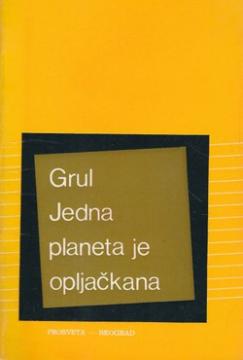
Jedna planeta je opljačkana : zastrašujući bilans jedne politike

Jedna planeta je opljačkana : zastrašujući bilans jedne politike

Herbert Grul

The book was published in September 1975 by the then CDU representative in the Bundestag, Herbert Gruhl. After the Club of Rome showed the "limits to growth" on our planet, Gruhl raised the question in this book about the remaining possibilities of our ec

In his book from 1975, Herbert Gruhl looked for the causes of the robbery of the ecological basis of humanity's life, which he saw in the ideology of growth (both capitalism and communism), and recommended renunciation and moderation instead of a consumer orientation. Gruhl also placed great importance on global population growth to plunder the planet. Here, environmental policy measures such as the reform of the environmental tax were given a boost. However, only encouraging technical environmental protection and other environmental protection policy measures will continue to be insufficient. A "planetary turn" is needed, which means that people must "think and act from the borders of the earth".

Gruhl's own assessment of whether "politicians or large sections of the people will understand the situation", i.e. give up on the path of economic and population growth, is cautious: "Perhaps the call will still reach the moving trains - although our assessment is more like that of the French poet Eugène Ionesca," who said that "there is no way out."

Original title
Ein Planet wird geplündert
Translation
Mira Flajšer
Editor
Miodrag Pavlović
Graphics design
Miodrag Vujčević Mirski
Dimensions
19 x 13 cm
Pages
455
Publisher
Prosveta, Beograd, 1985.
 
Distribution: 3,000 copies
 
Latin alphabet. Paperback.
Language: Serbian.

Two copies are available

Copy number 1

Condition:Used, excellent condition

Copy number 2

Condition:Used, excellent condition
 

Are you interested in another book? You can search the offer using our search engine or browse books by category.

You may also be interested in these titles

Odvodnja sa slavonske dravsko-dunavske nizine

Odvodnja sa slavonske dravsko-dunavske nizine

Stjepan Sršan, Dario Mlinarević

Project Ivana Nep. Spannbauera, 1876. g.

Državni arhiv u Osijeku, 2006.
Croatian. Latin alphabet. Paperback.
5.68
Stupovi društva

Stupovi društva

Srećko Jurdana
Media press, 1997.
Croatian. Latin alphabet. Paperback.
9.98
Kraj siromaštva: Ekonomske mogućnosti našeg doba

Kraj siromaštva: Ekonomske mogućnosti našeg doba

Jeffrey Sachs

In the book, economist Jeffrey Sachs presents an optimistic plan for eliminating extreme poverty by 2025. He argues that this is feasible with political will, because world wealth is growing, and poverty is not fate, but the result of inefficient systems.

Algoritam, 2007.
Croatian. Latin alphabet. Paperback.
9.78
Zagreb tisuću devetsto četrdeset prve

Zagreb tisuću devetsto četrdeset prve

Ivan Šibl

"Zagreb one thousand nine hundred and forty-first" is not only a historical overview of events, but at the same time it is also a book in which the author vividly and directly outlined dozens of portraits. A book that is at the same time a historiographic

Naprijed, 1967.
Croatian. Latin alphabet. Hardcover with dust jacket.
7.985.99
Slobodan Jovanović o socijalizmu i marksizmu : kritički osvrt na jedan oblik buržoaskog konzervatizma

Slobodan Jovanović o socijalizmu i marksizmu : kritički osvrt na jedan oblik buržoaskog konzervatizma

Borislav Milić
NIRO Književne novine, 1985.
Croatian. Latin alphabet. Paperback.
3.99
Zakon vrijednosti u staljinističkoj koncepciji

Zakon vrijednosti u staljinističkoj koncepciji

Dušan Dragosavac

Dragosavac first explains what the law of value is according to Karl Marx – the fundamental economic law of commodity production in which the exchange of goods depends on socially necessary working time.

Narodno sveučilište, 1976.
Croatian. Latin alphabet. Paperback with dust jacket.
7.98