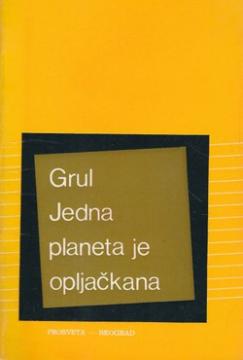
Jedna planeta je opljačkana: Zastrašujući bilans jedne politike

Jedna planeta je opljačkana: Zastrašujući bilans jedne politike

Herbert Grul

The book was published in September 1975 by the then CDU representative in the Bundestag, Herbert Gruhl. After the Club of Rome showed the "limits to growth" on our planet, Gruhl raised the question in this book about the remaining possibilities of our ec

In his book from 1975, Herbert Gruhl looked for the causes of the robbery of the ecological basis of humanity's life, which he saw in the ideology of growth (both capitalism and communism), and recommended renunciation and moderation instead of a consumer orientation. Gruhl also placed great importance on global population growth to plunder the planet. Here, environmental policy measures such as the reform of the environmental tax were given a boost. However, only encouraging technical environmental protection and other environmental protection policy measures will continue to be insufficient. A "planetary turn" is needed, which means that people must "think and act from the borders of the earth".

Gruhl's own assessment of whether "politicians or large sections of the people will understand the situation", i.e. give up on the path of economic and population growth, is cautious: "Perhaps the call will still reach the moving trains - although our assessment is more like that of the French poet Eugène Ionesca," who said that "there is no way out."

Original title
Ein Planet wird geplündert
Translation
Mira Flajšer
Editor
Miodrag Pavlović
Graphics design
Miodrag Vujčević Mirski
Dimensions
19 x 13 cm
Pages
455
Publisher
Prosveta, Beograd, 1985.
 
Distribution: 3,000 copies
 
Latin alphabet. Paperback.
Language: Serbian.

Two copies are available

Copy number 1

Condition:Used, excellent condition

Copy number 2

Condition:Used, excellent condition
 

Are you interested in another book? You can search the offer using our search engine or browse books by category.

You may also be interested in these titles

Zašto je ubijen Ivo Pukanić?

Zašto je ubijen Ivo Pukanić?

Berislav Jelinić

The best-selling Croatian journalistic book of 2009. The author, long-time journalist and editor of Nacional Berislav Jelinić (who succeeded Pukanić as head of the weekly), wrote it just a year after the assassination on October 23, 2008 in Zagreb.

Sljedeći savjet, 2014.
Croatian. Latin alphabet. Paperback.
24.56
Kako ostati bez domovine: Sedam koraka od demokracije do diktature

Kako ostati bez domovine: Sedam koraka od demokracije do diktature

Ece Temelkuran

In her book, Ece Temelkuran analyzes how societies are gradually sliding into authoritarianism. Through personal experiences and global examples, she reveals patterns of loss of freedom, compassion, and truth in the modern world.

Naklada Ljevak, 2019.
Croatian. Latin alphabet. Paperback.
12.32
Apocalypso

Apocalypso

Gorčin Stojanović

Apocalypso is a collection of prose texts (short stories, essays, feuilletons, lyrical fragments) by the famous Serbian director, screenwriter and critic Gorčin Stojanović (b. 1966).

Geopoetika, 2007.
Serbian. Latin alphabet. Paperback.
4.36
Bilježnica Robija K.

Bilježnica Robija K.

Viktor Ivančić

Robi's Notebook by K. Viktor Ivančić is a satirical book written in the form of a diary of an eight-year-old boy, Robi, through whose seemingly naive perspective the social and political absurdities of Croatia in the early 1990s are revealed.

Feral Tribune, 1994.
Croatian. Latin alphabet. Paperback.
22.36
Sjećanja na saradnju s Alijom Izetbegovićem

Sjećanja na saradnju s Alijom Izetbegovićem

Nihad Halilbegović

Nihad Halilbegović's book is a memoir testimony of long-term professional and personal cooperation with Alija Izetbegović, the first president of independent Bosnia and Herzegovina.

Fond kantona Sarajevo, 2018.
Croatian. Latin alphabet. Hardcover.
9.98
Krik solidarnosti

Krik solidarnosti

Marijo Drlje

Who cares about the common good, a solidary public healthcare system?

Vlastita naklada, 2011.
Croatian. Latin alphabet. Paperback.
6.19