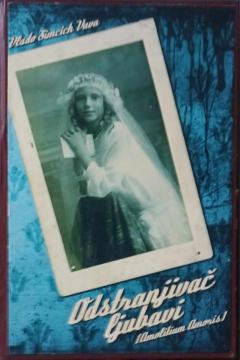
Odstranjivač Ljubavi (Amolitium amoris)
Ein rares Buch

Odstranjivač Ljubavi (Amolitium amoris)

Vlado Simcich-Vava

A collection of prose by Vlado Simčić Vava, containing four short stories and one short novel. A cynical, humorous and melancholic dissection of modern love relationships, emotional numbness and urban loneliness.

The literary debut of Rijeka musician, guitarist and rocker Vlad Simčić Vava (born 1964), known for his work with the band Laufer and his solo career. The book is a mix of short prose and a shorter novel, in which the author, in his recognizable, cynical and introspective way, deals with the themes of love, relationships, disappointment and emotional anesthesia in a contemporary urban environment.

Vava writes in a fluent, colloquial language full of rocker spirit, slang and irony. His characters are mostly men in their late thirties and forties who wander through relationships, trying to find meaning in love, and most often encounter emptiness, power games and their own internal conflicts. Love here is not a romantic ideal, but something that needs to be "removed" in order to survive in the harsh modern world - hence the title and the Latin play on words Amolitium Amoris (roughly "dissolver of love").

Of particular note is the afterword by Boris Perić, who describes the book as a "surgical instrument" with which the author dissects contemporary love illusions. The style is dynamic, witty and sometimes harsh, and the stories exude Rijeka's urban atmosphere, musical references and self-irony.

Odstranjivač ljubavi is the authentic voice of the Rijeka rock scene transferred to literature – a cynical, nostalgic and sharp depiction of male-female relationships in the 21st century. The book quickly found an audience among fans of contemporary Croatian prose who prefer direct, genuine and "street" expression.

Editor
Milan Zagorac
Titelseite
Mladen Stipanović
Maße
21,5 x 14,5 cm
Seitenzahl
126
Verlag
ICR d.o.o, Rijeka, 2012.
 
Latein Schrift. Hardcover.
Sprache: Kroatisch.
ISBN
978-9-53693-991-6

Angeboten wird ein Exemplar

Zustand:Gebraucht, in sehr gutem Zustand
Nachteile/Unannehmlichkeiten:
  • Slight damage to the cover
Zum Warenkorb hinzugefügt!
 

Interessieren Sie sich für ein anderes Buch? Sie können das Angebot über unsere Suchmaschine suchen und finden oder Bücher nach Kategorien durchsuchen.

Diese Titel könnten Sie auch interessieren

Bojovnici i bjegunci

Bojovnici i bjegunci

Branko Ćopić
Prosveta, 1964.
Serbisch. Latein Schrift. Taschenbuch.
2,96
Pripovijesti

Pripovijesti

Ivan Franko

Contents: Bricklayer, Good earnings, Forests and pastures, Gypsies, On the light, Lady's bread, Note about the writer

Zora, 1950.
Kroatisch. Latein Schrift. Taschenbuch.
2,96 - 2,98
Dijalektika prijelaznog perioda

Dijalektika prijelaznog perioda

Viktor Pelevin

The book represents the author's anthology - the largest part is the novel Čisla (Čisla), followed by the short story Macedonian Criticism of French Thought and several short stories (Odin vog, Akiko, Fokus-grupa, Gost na prazniku bon).

Disput, 2006.
Kroatisch. Latein Schrift. Taschenbuch.
9,68
Sabrana djela A. P. Čehova #1: Humoreske

Sabrana djela A. P. Čehova #1: Humoreske

Anton Pavlovič Čehov

This book includes Chekhov's works from 1880-1885, i.e. humoresques, short stories, and sketches, starting with Letters to a Learned Neighbor, which Chekhov considered the beginning of his literary career.

Zora, 1959.
Kroatisch. Latein Schrift. Fester Einband mit Schutzumschlag.
9,54
Sabrana djela A. P. Čehova #3: Drama u lovu i druge novele

Sabrana djela A. P. Čehova #3: Drama u lovu i druge novele

Anton Pavlovič Čehov

The third volume of Collected Works contains Chekhov's most extensive novella, "A Drama in Hunting," as well as a number of longer stories from the period 1885-1886. There are humoresques such as Silo in a Bag, Eh, That Audience, and A Lot of Paper, as we

Zora, 1959.
Kroatisch. Latein Schrift. Fester Einband mit Schutzumschlag.
8,74
Priče o braku i seksu

Priče o braku i seksu

Michal Viewegh

The book contains about twenty stories connected into one whole by the main character (the writer Oskar). It is, therefore, a kind of novel that, through intimate confessions, actually talks about the loneliness of the modern intellectual.

DiVič, 1999.
Kroatisch. Latein Schrift. Hardcover.
7,40 - 7,46