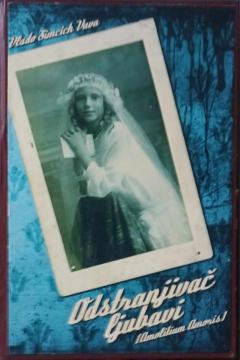
Odstranjivač Ljubavi (Amolitium amoris)
Rare book

Odstranjivač Ljubavi (Amolitium amoris)

Vlado Simcich-Vava

A collection of prose by Vlado Simčić Vava, containing four short stories and one short novel. A cynical, humorous and melancholic dissection of modern love relationships, emotional numbness and urban loneliness.

The literary debut of Rijeka musician, guitarist and rocker Vlad Simčić Vava (born 1964), known for his work with the band Laufer and his solo career. The book is a mix of short prose and a shorter novel, in which the author, in his recognizable, cynical and introspective way, deals with the themes of love, relationships, disappointment and emotional anesthesia in a contemporary urban environment.

Vava writes in a fluent, colloquial language full of rocker spirit, slang and irony. His characters are mostly men in their late thirties and forties who wander through relationships, trying to find meaning in love, and most often encounter emptiness, power games and their own internal conflicts. Love here is not a romantic ideal, but something that needs to be "removed" in order to survive in the harsh modern world - hence the title and the Latin play on words Amolitium Amoris (roughly "dissolver of love").

Of particular note is the afterword by Boris Perić, who describes the book as a "surgical instrument" with which the author dissects contemporary love illusions. The style is dynamic, witty and sometimes harsh, and the stories exude Rijeka's urban atmosphere, musical references and self-irony.

Odstranjivač ljubavi is the authentic voice of the Rijeka rock scene transferred to literature – a cynical, nostalgic and sharp depiction of male-female relationships in the 21st century. The book quickly found an audience among fans of contemporary Croatian prose who prefer direct, genuine and "street" expression.

Editor
Milan Zagorac
Graphics design
Mladen Stipanović
Dimensions
21.5 x 14.5 cm
Pages
126
Publisher
ICR d.o.o, Rijeka, 2012.
 
Latin alphabet. Hardcover.
Language: Croatian.
ISBN
978-9-53693-991-6

One copy is available

Condition:Used, very good condition
Damages or inconvenience notice:
  • Slight damage to the cover
 

Are you interested in another book? You can search the offer using our search engine or browse books by category.

You may also be interested in these titles

Prvo šišanje

Prvo šišanje

Bohumil Hrabal

The First Haircut, a short story written in 1970 and published in 1976, is the first in a series of prose pieces by Bohumil Hrabal describing Nymburk, the town where he spent his childhood. In 1981, The First Haircut was adapted for the screen by Jiry Men

24 sata, 2007.
Croatian. Latin alphabet. Paperback.
7.24
Sabrana djela A. P. Čehova #3: Drama u lovu i druge novele

Sabrana djela A. P. Čehova #3: Drama u lovu i druge novele

Anton Pavlovič Čehov

The third volume of Collected Works contains Chekhov's most extensive novella, "A Drama in Hunting," as well as a number of longer stories from the period 1885-1886. There are humoresques such as Silo in a Bag, Eh, That Audience, and A Lot of Paper, as we

Zora, 1959.
Croatian. Latin alphabet. Hardcover with dust jacket.
8.74
Talijanske kronike

Talijanske kronike

Marie-Henry Beyle Stendhal

Flipping through old Italian chronicles, Stendhal finds motifs for a series of his novels in which he depicts the passions of the Middle Ages and the unrestrained madness of the Renaissance.

Matica hrvatska, 1948.
Croatian. Latin alphabet. Hardcover with dust jacket.
9.36
Narodne pripovijetke

Narodne pripovijetke

Amira Idrizbegović

The book "Narodne povivitke" by Amira Idrizbegović from 1984 contains a collection of traditional folk stories that have been passed down orally through the generations.

Veselin Masleša, 1984.
Croatian. Latin alphabet. Hardcover.
4.68
Sabrana djela A. P. Čehova #1: Humoreske

Sabrana djela A. P. Čehova #1: Humoreske

Anton Pavlovič Čehov

This book includes Chekhov's works from 1880-1885, i.e. humoresques, short stories, and sketches, starting with Letters to a Learned Neighbor, which Chekhov considered the beginning of his literary career.

Zora, 1959.
Croatian. Latin alphabet. Hardcover with dust jacket.
9.54
Svetlosti Rima

Svetlosti Rima

Alberto Moravia

Through these stories, Moravia explores themes of social inequality, the struggle for survival, and human frailty, portraying them with a mix of humor, irony, and realistic observation.

Svjetlost, 1965.
Serbian. Latin alphabet. Paperback.
3.82 - 3.92