Italo Calvino
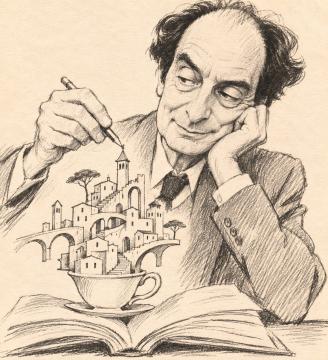
After a quarrel over lunch, a twelve-year-old boy climbs a tree and decides he will never come down. Italo Calvino builds The Baron in the Trees (Il barone rampante, 1957) around this stubborn decision. Life among the branches gives the boy a different view of the society he grew up in.
Calvino was born in Santiago de las Vegas, Cuba, in 1923, grew up in Sanremo and died in Siena in 1985. During the Second World War he joined the Italian partisans. His experience of the Resistance fed into his first novel, The Path to the Nest of Spiders (Il sentiero dei nidi di ragno, 1947), which shows the war through the eyes of a boy named Pin. He worked for the publisher Einaudi in Turin and in 1956 published Italian Folktales (Fiabe italiane), a selection of two hundred stories he collected and retold.
In Our Ancestors (I nostri antenati, 1960), he brought together The Cloven Viscount (1952), The Baron in the Trees and The Nonexistent Knight (1959). In these books, a man cut in two and an empty suit of armour come to life as convincingly as the boy in the branches. In Cosmicomics (Le cosmicomiche, 1965), scientific ideas prompt a similar kind of play. Calvino imagines, for instance, a time when the Moon was close enough to Earth to reach by ladder.
During his years in Paris he became involved with Oulipo, a group of writers who explored what happens when a story is built around a set of rules. In Invisible Cities (Le città invisibili, 1972), Marco Polo describes 55 imagined cities to Kublai Khan, giving Calvino a way to explore memory, desire and language. In If on a winter’s night a traveler (Se una notte d’inverno un viaggiatore, 1979), the reader becomes a character searching for the rest of a book, only to find the beginning of a different novel each time. Pavao Pavličić’s Croatian translation appeared in 1981.
In the late novel Mr. Palomar (1983), the title character tries to observe a single wave and discovers how hard it is to say where that wave begins and ends. The scene poses a question that runs through Calvino’s more elaborate literary games. How much does the world change when we change the way we look at it?
Titles in our offer

Ako jedne zimske noći neki putnik
A novel by the Italian writer Italo Calvino from 1979. The postmodernist narrative, in the form of a frame story, is about a reader who tries to read the book If One Winter Night a Traveler. Each chapter is divided into two parts.
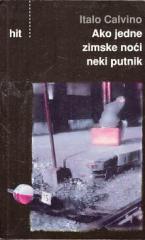
Ako jedne zimske noći neki putnik
A 1979 novel by Italian writer Italo Calvino. The postmodernist narrative, in the form of a frame story, tells the story of a reader trying to read the book If One Winter's Night a Traveler. Each chapter is divided into two parts.
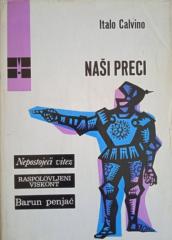
Naši preci : Nepostojeći vitez / Raspolovljeni viskont / Barun penjač

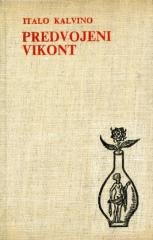
Predvojeni vikont
The Biscounted Viscount is a novel by Italo Calvino published in 1952. It is the first part of the Our Ancestors trilogy, which also includes the short novels The Baron in the Trees from 1957 and The Nonexistent Knight from 1959.