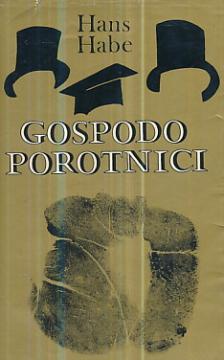
Gospodo porotnici

Gospodo porotnici

Hans Habe

In the whirlwind of post-war Europe, where the ruins of the past mingle with the turmoil of a new beginning, Hans Habe's novel Gentlemen of the Jurors (1955) takes us through a tense story about justice, morality, and human weaknesses.

Set in the American occupation zone of Germany in 1947, the novel follows the fate of a young American officer, Lieutenant Lee Barton, who faces the chaos and corruption of a shattered world. Barton, an idealist who believes in justice, arrives in Munich as part of the occupation forces. His mission is simple – to participate in denazification and help restore the legal order.

But he soon becomes entangled in a web of moral dilemmas. Germany is a country of hungry, desperate people, where the black market and corruption flourish, and Barton falls in love with Anna, a young German woman whose past hides dark secrets connected to the Nazi regime. Their love, intertwined with guilt and suspicion, becomes a battleground between duty and passion.

When Barton discovers that Anna may be hiding the truth about her role in the war, he is faced with the question: is love stronger than justice? At the same time, his superior, a cynical colonel, warns him of the dangers of interfering in German lives. The trial of a former Nazi official further complicates the situation, as Barton realizes that justice is not black and white, but clouded by human weaknesses and political games.

Habe, a witness to the post-war chaos himself, masterfully portrays the moral complexity of occupied Germany. Through Barton and Anna, the novel explores questions of forgiveness, guilt, and the possibility of a new beginning in a world scarred by the wounds of war. Gentlemen of the Jury is a poignant story of the search for truth in a time when justice was often an illusion and love a fragile hope amidst the ruins.

Naslov originala
Meine herren geschworenen
Prevod
Marija Eker Manolić
Naslovnica
Boris Dogan
Dimenzije
21 x 13 cm
Broj strana
357
Izdavač
Naprijed, Zagreb, 1966.
 
Latinica. Tvrde korice s omotom.
Jezik: Hrvatski.

Dva primerka su u ponudi

Primerak broj 1

Stanje:Korišćeno, u odličnom stanju
Dodato u korpu!

Primerak broj 2

Stanje:Korišćeno, u vrlo dobrom stanju
Oštećenja / nepogodnosti:
  • Traces of patina
  • Slight damage to the dust jacket
Dodato u korpu!
 

Zanima Vas i neka druga knjiga? Možete pretražiti našu ponudu pomoću pretrage ili prelistati knjige po kategorijama.

Možda će Vas zanimati i ovi naslovi

Amandino vjenčanje

Amandino vjenčanje

Jenny Colgan

A romantic comedy about friendship, love, and the chaotic attempts to save a good man from a bad marriage. A chick-lit hit, it reminds us that friendship saves more than any plan, and love comes unexpectedly.

Znanje, 2001.
Hrvatski. Latinica. Broširano.
5,36
Rudnik čvaraka

Rudnik čvaraka

Tomislav Šovagović

The debut work of Croatian writer Tomislav Šovagović, awarded the Josip and Ivan Kozarac Award in 2012, is a dedication to Slavonia – the region of his childhood that the author, born in Dalmatia, observes with foreign but tender eyes.

Mozaik knjiga, 20112.
Hrvatski. Latinica. Broširano.
11,56
Kreutzerova sonata, Hadži-Murat

Kreutzerova sonata, Hadži-Murat

Lav Nikolajevič Tolstoj

Kreutzer's sonata belongs to those works of Tolstoy that the writer adapted in many ways to his view on moral issues, on marital morality above all.

Civitas, 2004.
Hrvatski. Latinica. Broširano.
4,98
Magična ljubavna kutijica

Magična ljubavna kutijica

Santa Montefiore

The Magic Love Box (2002) follows the life story of Federica Campione, which begins in Vina del Mar, Chile, in the summer of 1982. Montefiore creates an epic story of growth, where the magic is not only in the box, but in the courage to let go of the past

Mozaik knjiga, 2006.
Hrvatski. Latinica. Tvrde korice.
7,34
Štefica Cvek u raljama života

Štefica Cvek u raljama života

Dubravka Ugrešić

Do you like "lovelies"? Whatever you think about them, you'll enjoy this superb pastiche of trivial romance novels.

Mladinska knjiga, 1990.
Hrvatski. Latinica. Tvrde korice s omotom.
4,94
Zagrepčanka

Zagrepčanka

Branislav Glumac

Branislav Glumac published a novel without periods or commas in 1974, as the relentless stream of thought of a young rebel. Published in socialist Yugoslavia, the work caused a scandal with its openness and became a classic about generational rebellion.

IROS, 1986.
Hrvatski. Latinica. Tvrde korice.
8,24