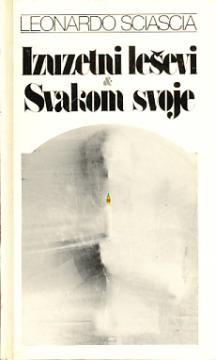
Izuzetni leševi / Svakom svoje

Izuzetni leševi / Svakom svoje

Leonardo Sciascia

Extraordinary Corpses and Each to His Own are two of the most famous political-crime novels by Leonardo Sciascia, an Italian writer and essayist who, through literature, dissected the mechanisms of power, corruption, and evil in contemporary society, espe

Both novels explore the deep-rooted relationships between the mafia, the judiciary, politics and ordinary people, with an emphasis on the moral and existential crisis of the individual in a world where justice is becoming increasingly abstract.

In "To Each His Own", the plot begins with the murder of a village pharmacist, which seems personal, but gradually reveals a network of political, mafia and social interests. The main character, Professor Laurana, tries to use logic and intellect to expose the crime, but his search for the truth ends tragically - which speaks of the powerlessness of the individual in the face of a system of silence and fear.

"Exceptional Corpses" depicts a series of political assassinations of high-ranking judicial officials, which raises the question: has the law become a means of power, not justice? The investigator in the novel gradually realizes that he is trapped in a situation where no one is interested in the truth - neither the system nor the public. The novel acts as an allegory of authoritarianism, showing how democracy can also turn into a repressive mechanism.

Sciascia writes precisely, ironically and intellectually deeply. His characters are not classic heroes – they are moral seekers in a world without landmarks. These novels, although styled as crime stories, are actually philosophical and political reflections on truth, power and responsibility.

Naslov originala
Il contesto, una parodia / A ciascuno il suo
Prevod
Tonko Maroević
Urednik
Nenad Popović
Naslovnica
Zoran Pavlović
Dimenzije
19,5 x 12 cm
Broj strana
228
Izdavač
Grafički zavod Hrvatske (GZH), Zagreb, 1981.
 
Latinica. Tvrde korice.
Jezik: Hrvatski.

Dva primerka su u ponudi

Primerak broj 1

Stanje:Korišćeno, u odličnom stanju
Dodato u korpu!

Primerak broj 2

Stanje:Korišćeno, u odličnom stanju
Dodato u korpu!
 

Zanima Vas i neka druga knjiga? Možete pretražiti našu ponudu pomoću pretrage ili prelistati knjige po kategorijama.

Možda će Vas zanimati i ovi naslovi

Krug Sestara

Krug Sestara

Roger R. Talbot

A suspenseful thriller that combines mysticism, history and contemporary intrigue. The plot takes place on several continents, from Russia and Afghanistan to London and Ireland, following two parallel stories connected by an ancient secret.

Lumen, 2014.
Hrvatski. Latinica. Broširano.
9,26
Ravnodušni ljudi

Ravnodušni ljudi

Alberto Moravia

The novel follows the declining Roman bourgeois family of Ardengo over the course of several days: widow Mariagrazia, lover Leo, son Michele, and daughter Carla – all trapped in apathy, lies, sexual manipulation, and moral indifference.

Otokar Keršovani, 1966.
Hrvatski. Latinica. Tvrde korice.
3,22
Rimske priče: izbor

Rimske priče: izbor

Alberto Moravia

Collections of short stories from Roman life in the post-war era: ordinary people from the people and the petty bourgeoisie – the poor, workers, small craftsmen – face misery, survival, jealousy, petty deceit and moral compromises in everyday life.

Otokar Keršovani, 1966.
Hrvatski. Latinica. Tvrde korice.
3,98
Konformist

Konformist

Alberto Moravia

Marcello Clerici, obsessed with normality after a traumatic childhood and a homosexual attack, becomes a fascist bureaucrat. He marries the average Giulia, and on their "honeymoon" in Paris, he is assigned to kill a former professor, anti-fascist Quadri.

Otokar Keršovani, 1966.
Hrvatski. Latinica. Broširano.
4,96
Svetlosti Rima

Svetlosti Rima

Alberto Moravia

Through these stories, Moravia explores themes of social inequality, the struggle for survival, and human frailty, portraying them with a mix of humor, irony, and realistic observation.

Svjetlost, 1965.
Srpski. Latinica. Broširano.
3,82 - 3,92
U sjeni bregova

U sjeni bregova

Paola Drigo

The novel depicts the tragic fate of Mariuta (Marije Zef) and her younger sister Rosuta. The work shocked contemporaries with its boldness in depicting taboo subjects, and is today considered a classic portrait of female suffering in rural Italy.

Matica hrvatska, 1961.
Hrvatski. Latinica. Tvrde korice s omotom.
5,32