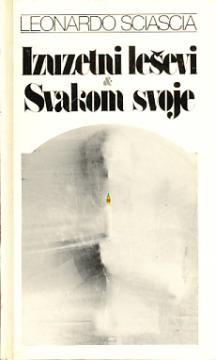
Izuzetni leševi / Svakom svoje

Izuzetni leševi / Svakom svoje

Leonardo Sciascia

Extraordinary Corpses and Each to His Own are two of the most famous political-crime novels by Leonardo Sciascia, an Italian writer and essayist who, through literature, dissected the mechanisms of power, corruption, and evil in contemporary society, espe

Both novels explore the deep-rooted relationships between the mafia, the judiciary, politics and ordinary people, with an emphasis on the moral and existential crisis of the individual in a world where justice is becoming increasingly abstract.

In "To Each His Own", the plot begins with the murder of a village pharmacist, which seems personal, but gradually reveals a network of political, mafia and social interests. The main character, Professor Laurana, tries to use logic and intellect to expose the crime, but his search for the truth ends tragically - which speaks of the powerlessness of the individual in the face of a system of silence and fear.

"Exceptional Corpses" depicts a series of political assassinations of high-ranking judicial officials, which raises the question: has the law become a means of power, not justice? The investigator in the novel gradually realizes that he is trapped in a situation where no one is interested in the truth - neither the system nor the public. The novel acts as an allegory of authoritarianism, showing how democracy can also turn into a repressive mechanism.

Sciascia writes precisely, ironically and intellectually deeply. His characters are not classic heroes – they are moral seekers in a world without landmarks. These novels, although styled as crime stories, are actually philosophical and political reflections on truth, power and responsibility.

Original title
Il contesto, una parodia / A ciascuno il suo
Translation
Tonko Maroević
Editor
Nenad Popović
Graphics design
Zoran Pavlović
Dimensions
19.5 x 12 cm
Pages
228
Publisher
Grafički zavod Hrvatske (GZH), Zagreb, 1981.
 
Latin alphabet. Hardcover.
Language: Croatian.

Two copies are available

Copy number 1

Condition:Used, excellent condition

Copy number 2

Condition:Used, excellent condition
 

Are you interested in another book? You can search the offer using our search engine or browse books by category.

You may also be interested in these titles

Život je igra

Život je igra

Alberto Moravia

Das Buch besteht aus mehreren Geschichten, die die Komplexität des menschlichen Verhaltens untersuchen, oft durch eine ironische und satirische Darstellung des Alltagslebens.

Svjetlost, 1965.
Serbian. Latin alphabet. Paperback.
3.46 - 3.72
Knjiga moga oca

Knjiga moga oca

Ethem Mandić

Dies ist eine Biografie meines Vaters, zusammengesetzt aus Erinnerungen und reiner Fantasie. Geschichte existiert nicht, und Fakten auch nicht. Die Vergangenheit ist unbekannt.

OKF d.o.o, 2016.
Croatian. Latin alphabet. Paperback.
10.64
Shannonov put

Shannonov put

Archibald Joseph Cronin

Cronins bewegende Geschichte der Erlösung. Robert Shannon, ein fanatischer Arzt und Forscher, opfert Liebe und Leben für die Wissenschaft, verliert aber am Ende alles – seine Freundin, Anerkennung, Gesundheit –, nur um durch sein Leiden zu erkennen: Mediz

Otokar Keršovani, 1966.
Croatian. Latin alphabet. Hardcover with dust jacket.
6.24
Posljednji harem

Posljednji harem

Peter Prange

Wenn Sie Tausendundeine Nacht mit einem historischen Twist lieben, ist dies eine sinnliche Harems-Saga – reichhaltig, emotional, unwiderstehlich! Ein epischer Roman über das Ende des Osmanischen Reiches, Haremsintrigen und die Geburt der modernen Türkei.

Naklada Ljevak, 2010.
Croatian. Latin alphabet. Paperback.
11.26
Tri mušketira 1-2

Tri mušketira 1-2

Alexandre Dumas

Dumas' version of the story depicts the adventures of d'Artagnan and his friends from 1625 to 1628.

Epoha, 1966.
Croatian. Latin alphabet. Hardcover with dust jacket.
The book consists of two volumes
9.48
Zagrepčanka

Zagrepčanka

Branislav Glumac

Branislav Glumac published a novel without periods or commas in 1974, as the relentless stream of thought of a young rebel. Published in socialist Yugoslavia, the work caused a scandal with its openness and became a classic about generational rebellion.

IROS, 1986.
Croatian. Latin alphabet. Hardcover.
8.22 - 8.24