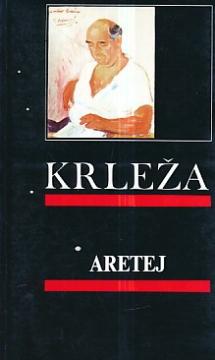

Aretej

Aretej

Miroslav Krleža

Krleža's drama about the doctor Areteus, a humanist who opposes the fanaticism, dogma and cruelty of society. The drama depicts the tragic position of an individual who remains faithful to reason in a world that rejects him.

In the play Aretêj, Miroslav Krleža creates a powerful portrait of the doctor Aretêj of Cappadocia, a man who, despite the chaos of the world around him, stubbornly adheres to an ethical principle: to save a person, regardless of their class, religion or political affiliation. The action is set in the late Roman Empire, during the persecution of Christians, social turmoil and moral decay. It is this historical framework that serves Krleža as a mirror of modernity — a dramatic portrayal of a man who remains committed to knowledge and humanity while the world surrenders to hatred and irrationality.

Aretêj finds himself between two fires: the Roman authorities, cruel and pragmatic, and the Christian communities that, although persecuted, show their own intolerance. His desire to help everyone brings him into conflict with both. At the heart of the play is his belief that a person is valuable for the very fact that he is a person, and not for belonging to a group. This is why the systems of power see him as a threat.

In Aretei, Krleža combines lyricism and thought: in his monologues one can feel the weariness of a man who sees the decline of values, but also the firm conviction that “a doctor must never stop healing”. The fate of the sick, wounded and rejected is depicted in dramatic scenes, and Aretei among them remains the last point of humanity.

Aretei is at the same time a historical picture and a philosophical drama, one of the highlights of Krleža's tragic literature. Through the fate of an individual who does not agree to hatred and ideological blindness, Krleža builds a universal story about resistance, moral responsibility and the price paid by a man who refuses to give up on good.

Urednik
Miroslav Prstojević
Ilustracije
Petar Dobrović
Naslovnica
Hrvoje Malić
Dimenzije
19,5 x 12 cm
Broj strana
211
Nakladnik
NIŠRO Oslobođenje, Sarajevo, 1988.
 
Latinica. Broširano.
Jezik: Hrvatski.
ISBN
8-63-190135-0

Jedan primjerak je u ponudi

Stanje:Korišteno, u odličnom stanju
Dodano u košaricu!
 

Zanima Vas i neka druga knjiga? Možete pretražiti našu ponudu pomoću tražilice ili prelistati knjige po kategorijama.

Možda će Vas zanimati i ovi naslovi

Izabrane pjesme

Izabrane pjesme

Miroslav Krleža
Matica hrvatska, 1963.
Hrvatski. Latinica. Tvrde korice s ovitkom.
9,99
Povratak Filipa Latinovicza

Povratak Filipa Latinovicza

Miroslav Krleža

„Die Rückkehr des Filip Latinovicz“ ist einer der berühmtesten Romane von Miroslav Krleža. Dieser Roman ist in unserer Literatur von Bedeutung, da er als der erste vollständig moderne kroatische Roman gilt.

Večernji list, 2004.
Hrvatski. Latinica. Tvrde korice s ovitkom.
5,52 - 5,56
Hrvatski bog Mars

Hrvatski bog Mars

Miroslav Krleža

Der kroatische Gott Mars bringt sieben Antikriegsromane hervor, in denen Krleža den Krieg als eine grausame, sinnlose Maschinerie darstellt, die den „kleinen Mann“ zerstört, und die Heuchelei des Militarismus und der Mythen über Heldentum entlarvt.

Rad, 1965.
Srpski. Latinica. Broširano.
1,99
Drame

Drame

Milutin Cihlar Nehajev

Der dritte Band der gesammelten Werke von Milutin Nehajev versammelt seine Stücke, die die Entwicklung des Autors von der jugendlichen Begeisterung zur reifen Selbstbeobachtung nachzeichnen: Prielom, Svjećica, Život, Spasitelj und Klupa na mješečini.

Hrvatski izdavalački bibliografski zavod (HIBZ), 1944.
Hrvatski. Latinica. Tvrde korice s ovitkom.
6,32
Zaplakala stara majka Džaferbegova: Drama u 3 čina

Zaplakala stara majka Džaferbegova: Drama u 3 čina

Jakša Kušan

Drama u tri čina Jakše Kušana nastalo prema motivima poznate bosanske sevdalinke istog naslova i predstavlja jedan od ranih Kušanovih dramskih radova inspiriranih muslimanskim ambijentom Bosne.

Tiskara braća Jakšić, 1942.
Hrvatski. Latinica. Broširano.
9,74
U Bečkom Novom Mjestu: Epilog zrinsko-frankopanskoj tragediji u jednom činu

U Bečkom Novom Mjestu: Epilog zrinsko-frankopanskoj tragediji u jednom činu

Milan Ogrizović

U Bečkom Novom Mjestu (1921.) je jednočinka – epilog Zrinsko-Frankopanskoj tragediji. Komemorira 250. obljetnicu pogubljenja Zrinskog i Frankopana u Bečkom Novom Mjestu 1671.

Matica hrvatska, 1921.
Hrvatski. Latinica. Broširano.
6,58