Mihail Bakunjin
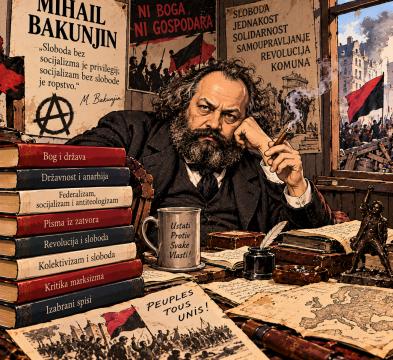
Mikhail Alexandrovich Bakunin (Pryamukhino, Russian Empire, May 30, 1814 – Bern, Switzerland, July 1, 1876) was a Russian revolutionary, philosopher, and political thinker, and one of the key founders of collectivist anarchism and international revolutionary socialism.
Born into a noble family, he was educated at a military academy in Saint Petersburg. After abandoning a military career, he devoted himself to philosophy, particularly the works of Georg Wilhelm Friedrich Hegel. During the 1840s, he lived in Germany, France, and Switzerland, where he met leading European revolutionaries, including Pierre-Joseph Proudhon and Karl Marx.
He participated in the revolutionary events of 1848 and 1849, including the uprising in Dresden. Following his arrest and years of imprisonment in German and Russian jails, he was exiled to Siberia. In 1861, he managed to escape to Europe via Japan and the United States, where he resumed his revolutionary activities.
Bakunin advocated for the abolition of the state, social equality, federalism, and the free association of workers and communities. He opposed all forms of authoritarian rule, including revolutionary dictatorship. His conflict with Marx regarding the organization of the workers' movement and the role of the state led to a split within the First International in 1872. Among his most important writings are Reaction in Germany (1842), Federalism, Socialism and Antitheologism (1867), State and Anarchy (1873) and the unfinished manuscript God and State, published posthumously in 1882. His texts about the Paris Commune, revolutionary organization and freedom are also important.
At the center of Bakunin's thought is the belief that individual freedom is not possible without the freedom of all, as well as true equality without liberation from political and economic domination.
Although his philosophy caused controversy, Bakunin strongly influenced the development of anarchist theory, revolutionary syndicalism and anti-authoritarian socialist movements. His discussions on the relationship between freedom, equality and government have remained important for political philosophy.
Naslovi u ponudi

Ispovijed
A harrowing account by a Russian revolutionary, written during his imprisonment under the Tsarist regime. Blending personal confession, political analysis, and an attempt at self-justification, it reveals the drama of the struggle for freedom.