Maksim Gorki
Maxim Gorky (real name Alexei Maksimovich Peshkov) was born on March 28, 1868 in Nizhny Novgorod and died on June 18, 1936 in Moscow. He was a Russian writer, revolutionary, and political activist. His name became synonymous with social realism and literature dedicated to the working class.
He grew up in difficult conditions, and after the death of his parents, he was forced to work various jobs. Strong social sensitivity shaped his creativity, and he translated the experiences of his youth into literary works. He became one of the key Russian writers of the turn of the 19th to the 20th century and an important ideologist of socialist realism.
His most important works include:
Autobiographical trilogy: Childhood (1913), In the World (1916), My Universities (1923)
Novel Mother (1906) – a key novel of social realism
Short stories and collections: Around Russia (1923), Fairy Tales of Italy (1911), Russian Fairy Tales
Drama At the Bottom (1902) – one of his most famous theatrical works
Gorky was active in political life, participated in the 1905 revolution, lived in exile, and returned to the USSR in 1932, where he became a symbol of Soviet literature.
Naslovi u ponudi
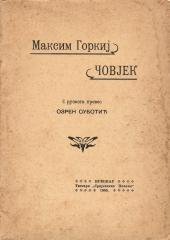
Čovjek
Man by Maxim Gorky, translated by Ozren Subotić (Vukovar, 1905), is a philosophical and literary work that glorifies the dignity of man, his creative power, freedom of spirit, and the fight against social injustice.
Djela #11: Gradić Okurov / Život Matveja Kožemjakina
The story "Gradić Okurov" is a short novel written by Gorki in 1909. The work depicts the life of the small provincial town of Okurova and its inhabitants, focusing on the monotony, stagnation and moral decadence of society.
Djela #13: Po Rusiji
„Po Rusiji“ je zbirka priča Maksima Gorkog, objavljena između 1911. i 1917. godine. Ova zbirka sadrži priče koje oslikavaju život i duh ruskog naroda tokom previranja početkom 20. veka.
Djela #14: Bajke o Italiji / Ruske bajke / Balada o grofici Elen de Kursi
"Tales of Italy" is a collection of short stories by Maxim Gorky, written during his stay in Italy at the beginning of the 20th century. "Russian Fairy Tales" is Gorky's interpretation of traditional Russian folk tales.
Djela #15: Pripovetke / Drame
The book contains the following stories and plays: Three Days, Theft, Criminals, Thefts, Fake Money and The Old Man.
Djela #16: Djetinjstvo
Prvi deo autobiografske trilogije Gorkog, objavljen 1913. godine, prikazuje teško odrastanje autora pod carskim režimom. Knjiga prati Alekseja Peškova (pravo ime Maksim Gorki) od njegovog ranog detinjstva do tinejdžerskih godina.
Djela #17: U svijetu
„U svetu“ je drugi deo autobiografske trilogije Maksima Gorkog, objavljene 1916. godine. Trilogija obuhvata dela „Detinjstvo”, „U svetu” i „Moji univerziteti”, pružajući uvid u godine formiranja autora.
Djela #18: Moji univerziteti
Neben dem autobiografischen Werk „Meine Universitäten“ enthält dieser Band auch die autobiografischen Kurzgeschichten Stražar, Koroljenkos Zeitalter, Über den Schaden der Philosophie und Über die erste Liebe.
Djela #7: U Americi / Moji intervjui / Vojnici / Neprijatelji
Maxim Gorky resided in the United States in 1906. During this period, he wrote several works, mostly in response to the failure of the Russian Revolution of 1905.