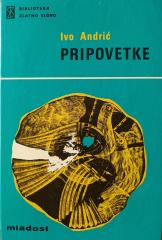
Ivo Andrić
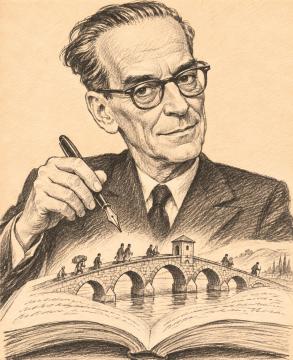
On a stone bench halfway across the Višegrad bridge, people stop to rest and hear the news. Rulers and generations change, and new stories reach the same spot. In The Bridge on the Drina (Na Drini ćuprija, 1945), Ivo Andrić follows the life of the town from the building of the bridge in the sixteenth century to the First World War. Great events enter the story when they change someone’s work, family or journey across the river.
Andrić was born in Travnik in 1892, spent part of his childhood in Višegrad and went to secondary school in Sarajevo. In 1914 his poems appeared in the anthology Hrvatska mlada lirika. During the First World War he was imprisoned and interned. In Ex Ponto (1918) and Nemiri (1920), his experience of solitude and uncertainty took the form of lyrical prose.
In 1920 he joined the diplomatic service of the Kingdom of Serbs, Croats and Slovenes, later Yugoslavia, and served as its envoy in Berlin from 1939 to 1941. He earned his doctorate in Graz in 1924 with a dissertation on the intellectual and spiritual life of Bosnia under Ottoman rule. During the Second World War he lived in Belgrade, where he worked on the novels that would reach his widest readership.
In 1945, alongside The Bridge on the Drina, he published Bosnian Chronicle (Travnička hronika) and The Woman from Sarajevo (Gospođica). In the first, French and Austrian consuls in Travnik try to find their bearings among people whose customs and relationships they are just beginning to understand. In the second, Rajka Radaković looks for security in saving money, which gradually shapes even her closest relationships.
In The Damned Yard (Prokleta avlija, 1954), Friar Petar hears stories in a Constantinople prison about Ćamil, a young man absorbed in the fate of the Ottoman prince Cem. The story within a story leaves readers wondering how much we can know about someone from what others say about them. Andrić received the Nobel Prize in Literature in 1961. He died in Belgrade in 1975, and his notes Signs by the Roadside (Znakovi pored puta) appeared posthumously in 1976.
Naslovi u ponudi

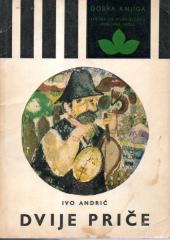
Dvije priče: Priča o kmetu Simanu / Bife "Titanik"
Two stories of individuals caught in historical upheaval: the peasant Siman expects freedom under a new government, while Sarajevo innkeeper Mento Papo faces Ustaša persecution and personal hatred.

Ispovijed i druge priče
The collection "Confession and Other Stories" brings together lesser-known, but extremely valuable, short stories by Andrić, written mainly in the period 1920–1940, some of which were only published posthumously.
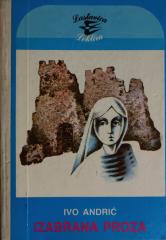
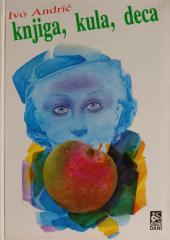
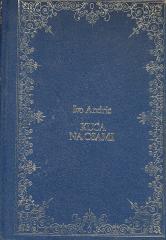
Kuća na osami
Postumno objavljena zbirka pripovedaka Ive Andrića u kojoj pisac u osami sarajevskog Alifakovca priziva i oživljava neobične sudbine prolaznika, osobenjaka i tragičnih junaka iz prošlosti Bosne.
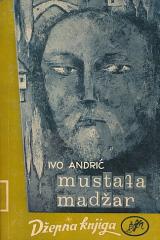
Mustafa Madžar i druge priče
Pripovjetka Mustafa Madžar opisuje život Mustafe Madžara, junaka iz Doboja koji se borio protiv Austrijanaca.
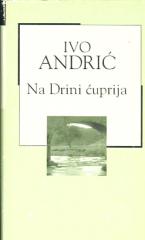
Na Drini ćuprija
Roman Ive Andrića objavljen 1945., remek-djelo je svjetske književnosti i dobitnik Nobelove nagrade 1961. Smješten u Višegradu, priča prati povijest mosta na Drini od 16. do 20. stoljeća, koji je sagradio Mehmed-paša Sokolović.
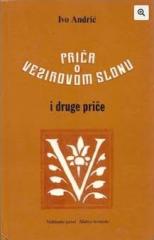
Priča o vezirovom slonu i druge priče