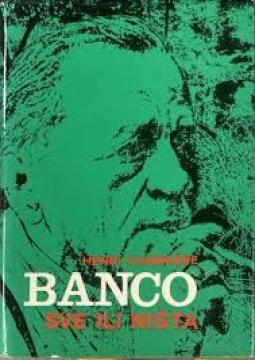
Banco: Sve ili ništa
Rare book

Banco: Sve ili ništa

Henri Charrière

In his book Banco – All or Nothing, Henri Charrière describes his life after escaping from prison in French Guiana. Seeking redemption, he embarks on an honest life, but through numerous adventures and shady dealings, he once again tests the limits of fre

Banco – All or Nothing is the sequel to Charrière’s world-famous novel Papillon. After escaping from a notorious penitentiary in French Guiana, Henri Charrière, known by his nickname “Papillon,” continues his life in Venezuela, trying to find a new beginning and redemption for his past. Although he is finally free, he faces new challenges – poverty, distrust and a constant desire for success.

Charrière decides to change his life, but the path to honesty is not easy. In Venezuela, he tries different jobs: from restaurateur and diver to goldsmith and jeweler. Each adventure brings a new test between the legal and the forbidden, because he is attracted by the risk and the spirit of the “all or nothing” game.

The author writes directly, with the same energy and vivid details as in Papillon, but now puts life, not survival, at the center. Banco is the story of a man who, in a world full of temptations, searches for a moral compass, faith in himself and the possibility of redemption.

It is an exciting and honest confession about freedom, human resilience and the need, despite everything, for man to find his peace outside the shackles - both of the law and of his own past.

Original title
Banco: La suite de l'aventure de Papillon
Translation
Marija Eker-Manolić
Editor
Boren Rašpica
Graphics design
Zvonimir Keček
Dimensions
22 x 16 cm
Pages
346
Publisher
Alfa, Zagreb, 1977.
 
Latin alphabet. Hardcover with dust jacket.
Language: Croatian.

One copy is available

Condition:Used, excellent condition
Damages or inconvenience notice:
  • Slight damage to the dust jacket
 

Are you interested in another book? You can search the offer using our search engine or browse books by category.

You may also be interested in these titles

Stranac

Stranac

Albert Camus

The Stranger is the novel with which Camus achieved his first great success, influenced by Nietzsche's philosophy, Sartre's philosophy of existentialism, and, most of all, his philosophy of the absurd.

Globus, 2004.
Croatian. Latin alphabet. Hardcover with dust jacket.
6.00 - 6.38
Robin Hood

Robin Hood

Alexandre Dumas

Dumas portrays Robin Hood not only as a bandit who helps the poor, but also as a heroic fighter for justice and a symbol of resistance to feudal injustice.

Epoha, 1966.
Croatian. Latin alphabet. Hardcover with dust jacket.
4.26 - 4.82
Evgenija Grande / Muzej starina

Evgenija Grande / Muzej starina

Honore de Balzac

In his novels Eugenie Grandet (1833) and The Museum of Antiquities (1837), Balzac explores universal themes of greed, human passions, sacrifice, and moral dilemmas, placing them in different social contexts of 19th-century French society.

Svjetlost, 1963.
Croatian. Latin alphabet. Hardcover.
3.48
Nježni rat

Nježni rat

Thierry Breton, Denis Beneich
Mladost, 1987.
Croatian. Latin alphabet. Paperback.
4.82
Bartolomejska noć: knjiga 1-2

Bartolomejska noć: knjiga 1-2

Alexandre Dumas

This book focuses on one of the bloodiest events in French history – St. Bartholomew's Day in 1572, when thousands of French Protestants were massacred in Paris and across the country.

Epoha, 1966.
Croatian. Latin alphabet. Hardcover with dust jacket.
The book consists of two volumes
9.36
Eugenija Grande

Eugenija Grande

Honore de Balzac

"Eugénie Grandet" (1833), part of Balzac's Human Comedy, is a realistic novel that explores greed, family relationships, and the sacrifices of love in provincial French society.

Svjetlost, 1981.
Croatian. Latin alphabet. Hardcover.
3.88