René Descartes
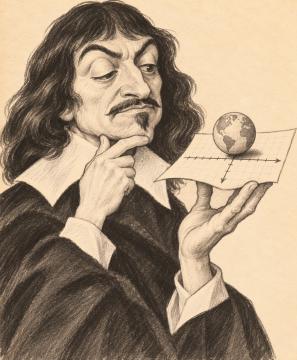
What can we be sure of if we doubt even whether we are awake? René Descartes starts with the experience of dreaming, when imagined scenes can feel as real as waking life. Yet while he doubts, he cannot doubt that he is thinking. From that simple act comes his best-known claim, “I think, therefore I am.”
Descartes (La Haye in Touraine, 1596 – Stockholm, 1650) was a French philosopher and mathematician. He was educated by the Jesuits at La Flèche, studied law at Poitiers and spent much of his working life in the Netherlands. In 1649 he accepted an invitation from Queen Christina of Sweden and moved to Stockholm, where he died the following year.
In the Discourse on the Method (Discours de la méthode, 1637), he describes his own search for reliable knowledge. One of his rules applies well beyond philosophy. Break a difficult problem into smaller parts, then begin with the simplest. In Geometry (La Géométrie), published alongside the Discourse, he brought algebra and geometry together, showing how a curve could be investigated through an equation.
In the Meditations on First Philosophy (1641), doubt becomes a thought experiment. Descartes imagines a deceiver powerful enough to mislead him even in arithmetic. From this experiment he develops an inquiry into the existence of God, the reliability of knowledge and the distinction between the thinking mind and the body that occupies space.
In the Principles of Philosophy (1644), he tries to explain nature and the motion of bodies from general principles. In The Passions of the Soul (1649), he turns to the emotions and asks how bodily changes affect what we experience. The question has an everyday side. Fear or anger can prompt us to act before we have had time to judge what has happened.