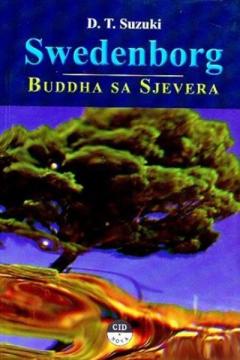
Swedenborg - Buda sa sjevera

Swedenborg - Buda sa sjevera

Daisetz Teitaro Suzuki

Writing about the Swedish mystic Emanuel Swedenborg and his theological work, Daisetsu Teitaro Suzuki, a great scholar of the Buddhist tradition, points to the existence of a similar principle in the spiritual tradition of the West.

"Swedenborg said that he had traveled through heaven and hell, and had seen in detail the real conditions of men after death. His statements are quite honest. They are free from the slightest exaggeration, and, viewed from the point of view of common sense, appear to be very much in agreement with indeed. That is the first reason why Swedenborg is interesting." D.T. Suzuki 'Swedenborg, Buddha of the North - opening speech'

In the context of Christianity, Christ's life on earth is part of our everyday life. For Buddhists, as for Swedenborg, enlightenment is the result of intuitive knowledge, not a purely rational approach. True goodness is not achieved by knowledge, but by the realization that, although it is not good in itself, a "Higher/Other Force" makes a person good. The goal of spiritual life is to surrender to the influence of that Force. It is precisely this similarity between Buddhism and Swedenborg's interpretation of Christianity that may have led Suzuki to once, in a conversation with the famous professor of Islamic Studies from the Sorbonne, Henry Corbin, declare that for Westerners, Swedenborg is "your Buddha from the North." Hence the name of the book.

Titel des Originals
Buddha of the North
Übersetzung
Lorens Novosel
Maße
20 x 14 cm
Seitenzahl
159
Verlag
CID-NOVA, Zagreb, 2013.
 
Latein Schrift. Taschenbuch.
Sprache: Kroatisch.
ISBN
978-9-53311-020-2

Im Angebot sind keine Exemplare vorhanden

Das letzte Exemplar wurde kürzlich verkauft.
 

Interessieren Sie sich für ein anderes Buch? Sie können das Angebot über unsere Suchmaschine suchen und finden oder Bücher nach Kategorien durchsuchen.

Diese Titel könnten Sie auch interessieren

Dođi, imam ti nešto reći

Dođi, imam ti nešto reći

Marija Valtorta

"Come, I Have Something to Tell You" is one of the popular collections of spiritual reflections and messages by Maria Valtorta (1897–1961), an Italian mystic and visionary known for her extensive work "The Gospel as Revealed to Me."

Don Božidar Medvid, 1985.
Kroatisch. Latein Schrift. Taschenbuch.
4,58
Zamak duše

Zamak duše

Terezija Avilska

The Castle of the Soul is the most famous mystical work of Saint Teresa of Avila, in which, through the image of a castle with many chambers, she describes the soul's journey from conversion to complete union with God.

Kršćanska sadašnjost, 1997.
Kroatisch. Latein Schrift. Taschenbuch.
16,32
Čarobnost mističkog života

Čarobnost mističkog života

Anđela Sorazu

„Magija mističnog života“ je duhovno-asketsko delo sestre Marije Anhele Sorazu i Aizpuru (1873–1921), baskijske klarise (samostan u Valjadolidu, Španija).

Symposion, 1980.
Kroatisch. Latein Schrift. Taschenbuch.
14,36
Skriveno lice vremena

Skriveno lice vremena

Michael Hulin

„Das verborgene Gesicht der Zeit“ (1985) von Michel Hulin, einem französischen Indologen und Religionshistoriker, untersucht das Konzept von Tod und Leben nach dem Tod durch eine vergleichende Analyse verschiedener Kulturen und religiöser Traditionen.

Naprijed, 1989.
Kroatisch. Latein Schrift. Fester Einband mit Schutzumschlag.
11,52
Pakao

Pakao

Miro Glavurtić

Glavurtićs spirituell-theologische Studie über Hölle, Dämonen und das Jenseits. Ein christlich-mystischer und dämonologischer Bericht mit dem Ziel der Warnung und spirituellen Erweckung des modernen Menschen. Erste Auflage.

Vlastita naklada, 1986.
Kroatisch. Latein Schrift. Taschenbuch.
14,95
Mistika

Mistika

Louis Gardet

Das Buch befasst sich mit einer eingehenden Analyse mystischer Erfahrungen in verschiedenen religiösen Traditionen, mit Schwerpunkt auf Christentum und Islam. Gardet, ein französischer Theologe und Orientalist, untersucht Mystizismus als universelles Phän

Kršćanska sadašnjost, 1983.
Kroatisch. Latein Schrift. Taschenbuch.
7,325,12