Bormannova braća idu dalje

Bormannova braća idu dalje

William Stevenson

The book reveals the secret network through which Martin Bormann, Hitler's treasurer, ensured the survival of Nazi power and capital after the fall of the Third Reich.

The Bormann Brothers Go On is an investigative story about the hidden continuation of the Nazi project after 1945. William Stevenson, a journalist and author known for his documentary approaches to real events, develops the thesis that Martin Bormann, a key figure in Hitler's inner circle and the financial manager of the Third Reich, prepared a large escape network during the war, known as the "Bormann Organization" or "Bormann Brotherhood".

According to the author, through a complex network of companies, banks and contacts around the world, Bormann ensured the escape of numerous high-ranking Nazis to South America, where they created new economic and political power under the auspices of industrial conglomerates. Stevenson argues that Nazi capital and connections continued to operate outside of Germany and influenced post-war geopolitics, the Cold War and international business circles.

The book combines elements of investigative journalism, historical reconstruction and spy fiction, often on the border between documented facts and controversial theories. Stevenson tries to show that Nazism did not end with the war, but transformed into a covert network of power operating behind the scenes of global politics and economics.

Original title
The Bormann Brotherhood
Translation
Vlasta Švarcmajer
Editor
Milan Osmak
Dimensions
20 x 12 cm
Pages
199
Publisher
Vjesnik, Zagreb, 1977.
 
Latin alphabet. Hardcover.
Language: Croatian.

One copy is available

Condition:Used, excellent condition
 

Are you interested in another book? You can search the offer using our search engine or browse books by category.

You may also be interested in these titles

Ilustrirana povijest svijeta: Od 1945. do Hladnog rata

Ilustrirana povijest svijeta: Od 1945. do Hladnog rata

Neil Morris

The book explains how, after 1945, the world was divided into two opposing blocs: the Western (led by the USA) and the Eastern (led by the Soviet Union).

24 sata, 2011.
Croatian. Latin alphabet. Hardcover.
5.00
Filozofija revolucije

Filozofija revolucije

Gamal Abdel Nasser

G. A. Nasser's Philosophy of Revolution is a political manifesto and ideological program of the Egyptian Revolution of 1952. In it, Nasser explains the motives of the revolution, the role of Egypt in the Arab and African world, and the vision of Arab nati

Džepna knjiga, 1956.
Serbian. Latin alphabet. Paperback.
9.56
Bitka za Moskvu

Bitka za Moskvu

Branko Kitanović

The Battle of Moscow is a historical account of the German Operation "Barbarossa", the Soviet defense and counteroffensive in 1941. The author, with the testimonies of the top Soviet military leaders, shows how the first German defeat in the war unfolded.

Alfa, 1975.
Croatian. Latin alphabet. Hardcover with dust jacket.
7.96
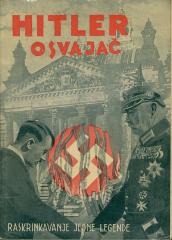
Hitler osvajač: raskrinkavanje jedne legende

Hitler osvajač: raskrinkavanje jedne legende

Rudolf Olden

One of the first anti-Hitler works, published by Nolit as early as 1933. This is an early, shorter version of the work (originally published anonymously in Prague), which preceded the expanded edition from Amsterdam in 1935.

Nolit, 1933.
Croatian. Latin alphabet. Hardcover with dust jacket.
15.32
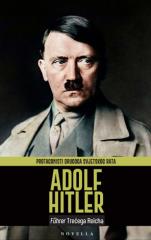
Adolf Hitler - Führer Trećega Reicha

Adolf Hitler - Führer Trećega Reicha

Joan Solé

In the book, Joan Solé shows the life, ideology and rise of Adolf Hitler. The book explores how a charismatic but fanatical leader shaped a totalitarian regime and plunged the world into one of the most tragic wars in history.

Twins Company d.o.o., 2025.
Croatian. Latin alphabet. Paperback.
8.56