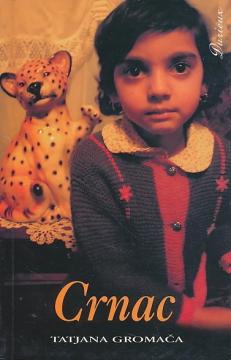
Crnac

Crnac

Tatjana Gromača

The novel The Black Man begins with the sentence “The house we lived in was wooden.” Wooden houses are reserved for fairy tales and stories for children.

The author does indeed write about childhood, a childhood that could be hers, but the narrator has no name, nor does the village she lives in, nor the city she goes to study in. The novel is composed of short fragments that sometimes read as short stories, sometimes as flashes of memory, and sometimes as prose poems. There are no elements of a fairy tale in the narrator's childhood, quite the opposite. In the suburbs of a provincial town known for its heavy industry, the child grows up surrounded by poverty, provincialism, and the subtle terror of people living empty lives. Going to study in a big city doesn't change anything either. The streets are bigger, a little better lit, but people with "empty gazes" still follow her. Gromača writes about the same Eastern European poverty described by Slavenka Drakulić, the same attitude towards women that Dubravka Ugrešić wrote about, but her prose fragments are closer to Danilo Kiš's novel The Garden, Ashes, Milan Kundera's The Joke, Agota Kristof's The Great Notebook, and Szymborska's poetry. Tatjana, like all good poets, knows how to say a lot with few words.

Editor
Nenad Popović
Maße
20 x 13 cm
Seitenzahl
159
Verlag
Durieux, Zagreb, 2004.
 
Latein Schrift. Taschenbuch.
Sprache: Kroatisch.

Angeboten wird ein Exemplar

Zustand:Gebraucht, in ausgezeichnetem Zustand
Zum Warenkorb hinzugefügt!
 

Interessieren Sie sich für ein anderes Buch? Sie können das Angebot über unsere Suchmaschine suchen und finden oder Bücher nach Kategorien durchsuchen.

Diese Titel könnten Sie auch interessieren

Knjižarevo obećanje: Cliff Janeway istražuje

Knjižarevo obećanje: Cliff Janeway istražuje

John Dunning

Knjižarevo obećanje treća je knjiga u seriji o Cliffu Janewayu nagrađivanog Johna Dunninga, američkog spisatelja neobično talentiranog i jedinstvenog kao i knjige koje tako iskreno voli i prodaje u svojoj knjižari i antikvarijatu Old Algonquin u Denveru.

Algoritam, 2006.
Kroatisch. Latein Schrift. Taschenbuch.
4,50 - 4,68
I ne reče ni reči

I ne reče ni reči

Heinrich Böll

U Bolovim romanima, jedna od centralnih tema je pokušaj očuvanja osnovnih moralnih vrednosti u vremenu terora, kao i u periodu materijalnog prosperiteta i korupcije.

Svjetlost, 1965.
Serbisch. Latein Schrift. Taschenbuch.
3,22 - 3,98
Krčma

Krčma

Julian Stryjkowski

Knjiga Julijana Strijkovskog „Svratište“, objavljena 1977. godine, istražuje život u malom jevrejskom selu u Galiciji tokom 19. veka.

BIGZ, 1977.
Serbisch. Latein Schrift. Taschenbuch.
4,38
Pripovetke iz levog i desnog džepa

Pripovetke iz levog i desnog džepa

Karel Čapek

Ove priče bave se različitom tematikom mada se većina bavi različitim kriminalnim radnjama, od prevara i gatanja do bračnih prevara i ubistava.

Jugoslavijapublik, 1980.
Kroatisch. Latein Schrift. Hardcover.
5,22
V.

V.

Thomas Pynchon

Der Roman stellt eine Reise in eine alternative Welt dar – eine Welt, zu der wir alle von Zeit zu Zeit gehören, von der wir aber nicht Teil sein möchten, eine Welt der Paranoia und Entfremdung, bei der wir uns nicht ganz sicher sind, ob es sich nur um ein

Čarobna knjiga, 2010.
Serbisch. Latein Schrift. Taschenbuch.
21,98
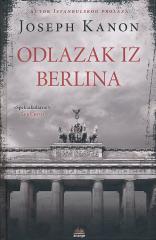
Odlazak iz Berlina

Odlazak iz Berlina

Joseph Kanon

Hladnoratovski triler koji uvjerljivo prenosi napetu atmosferu u Njemačkoj po završetku Drugog svjetskog rata.

Znanje, 2016.
Kroatisch. Latein Schrift. Taschenbuch.
4,14 - 4,16