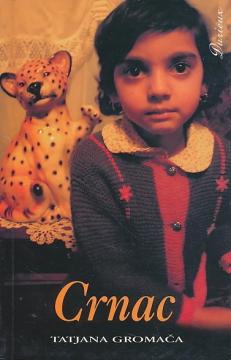
Crnac

Crnac

Tatjana Gromača

The novel The Black Man begins with the sentence “The house we lived in was wooden.” Wooden houses are reserved for fairy tales and stories for children.

The author does indeed write about childhood, a childhood that could be hers, but the narrator has no name, nor does the village she lives in, nor the city she goes to study in. The novel is composed of short fragments that sometimes read as short stories, sometimes as flashes of memory, and sometimes as prose poems. There are no elements of a fairy tale in the narrator's childhood, quite the opposite. In the suburbs of a provincial town known for its heavy industry, the child grows up surrounded by poverty, provincialism, and the subtle terror of people living empty lives. Going to study in a big city doesn't change anything either. The streets are bigger, a little better lit, but people with "empty gazes" still follow her. Gromača writes about the same Eastern European poverty described by Slavenka Drakulić, the same attitude towards women that Dubravka Ugrešić wrote about, but her prose fragments are closer to Danilo Kiš's novel The Garden, Ashes, Milan Kundera's The Joke, Agota Kristof's The Great Notebook, and Szymborska's poetry. Tatjana, like all good poets, knows how to say a lot with few words.

Editor
Nenad Popović
Dimensions
20 x 13 cm
Pages
159
Publisher
Durieux, Zagreb, 2004.
 
Latin alphabet. Paperback.
Language: Croatian.

One copy is available

Condition:Used, excellent condition
 

Are you interested in another book? You can search the offer using our search engine or browse books by category.

You may also be interested in these titles

Dok ležah na samrti

Dok ležah na samrti

William Faulkner

Faulkner's 1930 novel, a classic example of modernist literature. It is often compared to Joyce's "Ulysses" for its innovative structure, but is more accessible due to its focus on family.

Rad, 1985.
Croatian. Latin alphabet. Paperback.
3.26
Kad žena zri

Kad žena zri

Honore de Balzac
Svjetlost, 1970.
Croatian. Latin alphabet. Hardcover.
4.99 - 5.00
Usta puna zemlje

Usta puna zemlje

Branimir Šćepanović

The novel "Usta puna zemlje" (1970), the masterpiece of the Serbian writer Branimir Šćepanović, is a psychologically in-depth explorer of the limits of the human soul, solitude and existential freedom, reminiscent of Kafka and Camus.

BIGZ, 1987.
Serbian. Latin alphabet. Paperback.
3.98
Andrićeva lestvica užasa

Andrićeva lestvica užasa

Svetislav Basara

A Serbian writer known for his satirical novels, Andrić's Ladder of Horrors dissects the Balkan mentality through a parable of Yugo-nostalgia and national myths. The title alludes to Ivo Andrić as a litmus test for criticism – Balkans claim him or reject

24 sata, 2021.
Serbian. Latin alphabet. Paperback.
11.56
Godan

Godan

Munshi Prem Chand
Kosmos, 1960.
Serbian. Latin alphabet. Paperback.
4.22 - 4.26
Pripovetke iz levog i desnog džepa

Pripovetke iz levog i desnog džepa

Karel Čapek

These stories deal with different topics, although most deal with different criminal acts, from fraud and fortune-telling to marriage fraud and murder.

Jugoslavijapublik, 1980.
Croatian. Latin alphabet. Hardcover.
5.22