Starohrvatska seoska zajednica
Ein rares Buch

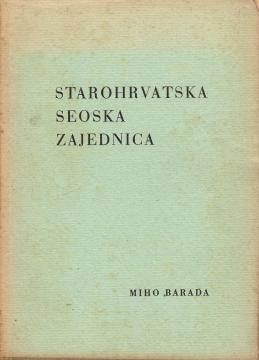
Starohrvatska seoska zajednica

Miho Barada

In his work Starohrvatska seoska zajednica (The Old Croatian Village Community) (1957), Miho Barada analyzes the social and agrarian organization of early medieval Croatian villages, their institutions, ownership relations, and common land based on origin

The most important and life-long work of Don Miha Barada (1889–1957), a prominent Croatian historian, paleographer, archaeologist and priest. The book represents a thorough scientific investigation of the organization of ancient Croatian society in the early Middle Ages, with special emphasis on the village community as the basic social unit.

Barada studies in detail the structure of the ancient Croatian village: the form of land ownership (joint and individual), forms of management, family cooperatives, village elders, legal customs and relations between peasants and nobility. Based on Latin documents, cartulary and other medieval sources, he reconstructs how the village community functioned before and after the settlement of Croats, and how it developed under the influence of feudalization.

The work is written in the precise, documented style characteristic of Barada – erudite, but clear. It represents a significant contribution to the understanding of early feudal social relations in Croatia and the wider South Slavic area. It was published in the year of Barada's death (the author died while finishing the proofreading), and it remains a fundamental reference work for all those concerned with Croatian medieval history, agrarian relations and social organization.

With 186 pages of expert analysis, the book is still an indispensable piece of literature in Croatian historiography. It is appreciated for its thoroughness, critical approach to sources and the importance of the topics it covers – from cooperatives and rural self-government to the process of feudalization. It represents the crown of Barada's scholarly oeuvre and an important stone in the mosaic of understanding ancient Croatian society.

Editor
Ferdo Čulinović
Maße
23,5 x 17 cm
Seitenzahl
186
Verlag
Jugoslavenska akademija znanosti i umjetnosti (JAZU), Zagreb, 1957.
 
Latein Schrift. Taschenbuch.
Sprache: Kroatisch.

Angeboten wird ein Exemplar

Zustand:Gebraucht, in ausgezeichnetem Zustand
Nachteile/Unannehmlichkeiten:
  • Traces of patina
Zum Warenkorb hinzugefügt!
 

Interessieren Sie sich für ein anderes Buch? Sie können das Angebot über unsere Suchmaschine suchen und finden oder Bücher nach Kategorien durchsuchen.

Diese Titel könnten Sie auch interessieren

Izvještaj za školsku godinu 1939/40. - Učiteljska škola i vježbaonica u Osijeku

Izvještaj za školsku godinu 1939/40. - Učiteljska škola i vježbaonica u Osijeku

Official annual report of the State Teachers' School with a Training Room (Primary School) in Osijek, published in 1940. Overview of teaching work, students, staff and activities on the eve of World War II.

Narodne novine, 1940.
Kroatisch. Latein Schrift. Taschenbuch.
12,26
Erne Kiš 1909-1941

Erne Kiš 1909-1941

Nada Lazić

Biography of revolutionary Erno Kiš (1909–1941), a prominent communist and anti-fascist from Baranja-Bačka. An account of his life, political struggle and suffering on the eve and at the beginning of World War II.

OK SKH, 1984.
Kroatisch. Latein Schrift. Hardcover.
9,76
Palača cara Dioklecijana u Splitu

Palača cara Dioklecijana u Splitu

Frane Bulić, Ljubo Karaman

The work of Bulić and Karaman depicts the creation and development of Diocletian's Palace in Split, its historical transformation and significance as a monument of Roman architecture and later an urban center.

Matica hrvatska, 1927.
Kroatisch. Latein Schrift. Hardcover.
12,46
Oluja koju nismo mogli izbjeći

Oluja koju nismo mogli izbjeći

Ante Gugo

Ante Gugo explains the breakup of Yugoslavia, the formation of the Croatian state, and the circumstances that led to Operation Storm through a chronological account of events from 1985 to 1995.

Večernji list, 2015.
Kroatisch. Latein Schrift. Taschenbuch.
18,42
Vjesnik Hrvatskoga arheološkoga društva, sv III. / 1898

Vjesnik Hrvatskoga arheološkoga društva, sv III. / 1898

Josip Brunšmid, Vjekoslav Klaić, Fran Bulić, Emilij Laszowski, Luka Jelić

The third volume of "Vjesnik" for 1898 contains genealogical and historical contributions on the Croatian nobility, archaeological and epigraphic studies, ethnological and military-topographic sketches, and a report on the work of the historical society.

Hrvatsko arheološko društvo, 1899.
Kroatisch. Latein Schrift. Hardcover.
32,56
Čardaci – mraclinska povijest i naslijeđe

Čardaci – mraclinska povijest i naslijeđe

Ratko Cvetnić, Tomislav Krešimir Hubak, Maja Ergović, Iva Brozinčević, Stjepan Galeković, Vasna T...

The collection "Čardaki - Mraclin history and heritage" is a richly illustrated booklet about the Turopolje čardaki as a symbol of the Mraclin tradition, life and heritage.

KUD Dučec, 2024.
Kroatisch. Latein Schrift. Taschenbuch.
7,34