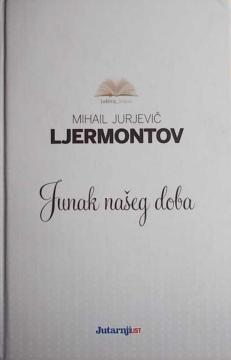
Junak našeg doba

Junak našeg doba

Mihail Jurjevič Ljermontov

The hero of our time is a novel by the Russian writer Mihail J. Ljermontov, published in 1840. It is considered one of the first psychological novels in Russian literature and an important work of Russian romanticism with elements of realism.

The main character, Pechorin, is a complex and contradictory anti-hero - cynical, intelligent, but also emotionally cold. Through a series of narrative fragments, Ljermontov explores his character and motives. The action is set in the Caucasus, where Pechorin goes through a series of adventures, including duels, love intrigues and existential crises.

The novel is divided into five stories, in which Pechorin is presented from different perspectives: through the narration of his friend, simple captain Maksim Maksimič, about a long-ago event (Bela); from the author's point of view, who tells about a chance meeting with Pechorina (Maksim Maksimič). This is followed by a novel in which the main character narrates in the first person (Tamanj), followed by his diary in which he reveals the secrets of his soul (Kneginjica Meri) and a synthesis of the novel - Pechorin's meditation on fate (Fatalist).

Lermontov criticizes the noble elite, portraying Pechorin as a symbol of a generation of lost idealists who are cynical and incapable of true happiness. The work is significant for its innovative structure, introspective approach and analysis of the human psyche, and Pechorin, the forerunner of the "superfluous man", remains one of the most famous characters in Russian literature.

Titel des Originals
Герой нашего времени
Übersetzung
Milan Bogdanović
Editor
Ivica Buljan
Titelseite
Halid Malla
Maße
20 x 13 cm
Seitenzahl
142
Verlag
Jutarnji list, Zagreb, 2008.
 
Latein Schrift. Hardcover.
Sprache: Kroatisch.
ISBN
978-9-53300-058-9

Weitere Exemplare sind verfügbar
Kopiennummer 1

Zustand:Gebraucht, in ausgezeichnetem Zustand
Zum Warenkorb hinzugefügt!

Kopiennummer 2

Zustand:Gebraucht, in ausgezeichnetem Zustand
Zum Warenkorb hinzugefügt!

Kopiennummer 3

Zustand:Gebraucht, in ausgezeichnetem Zustand
Zum Warenkorb hinzugefügt!

Kopiennummer 4

Zustand:Gebraucht, in ausgezeichnetem Zustand
Zum Warenkorb hinzugefügt!

Kopiennummer 5

Zustand:Gebraucht, in ausgezeichnetem Zustand
Zum Warenkorb hinzugefügt!
 

Interessieren Sie sich für ein anderes Buch? Sie können das Angebot über unsere Suchmaschine suchen und finden oder Bücher nach Kategorien durchsuchen.

Diese Titel könnten Sie auch interessieren

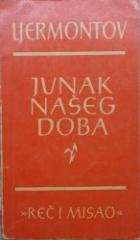
Junak našeg doba

Junak našeg doba

Mihail Jurjevič Ljermontov
Rad, 1962.
Serbisch. Latein Schrift. Taschenbuch.
1,99
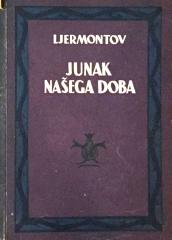
Junak našega doba

Junak našega doba

Mihail Jurjevič Ljermontov

A Hero of Our Time is a novel by Russian writer Mikhail Y. Lermontov, published in 1840. It is considered one of the first psychological novels in Russian literature and an important work of Russian Romanticism with elements of realism.

Nakladni zavod Matice hrvatske, 1947.
Kroatisch. Latein Schrift. Hardcover.
5,98
Jedna Swannova ljubav / Preobražaj / Čovjekova sudbina

Jedna Swannova ljubav / Preobražaj / Čovjekova sudbina

Marcel Proust, Franz Kafka, Mihail Šolohov

The selection of titles of selected high school reading offered in this way is threefold in its thematic focus, which is seen in Proust in the old world, in Sholokhov in the new life, and in Kafka in the unreliable sign of man.

Stvarnost, 1989.
Kroatisch. Latein Schrift. Taschenbuch.
8,74
Moskva – Petuški

Moskva – Petuški

Venjedikt Jerofejev

Venedikt Yerofeyev's postmodern prose poem is today considered a classic of new Russian literature. It is compared to Gogol and Kharms for its poetics of absurdity, satire, and metaphysical depth.

LOM, 217.
Serbisch. Kyrillisch Schrift. Taschenbuch.
11,24
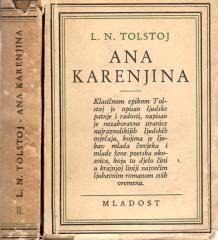
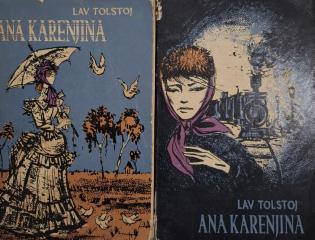
Ana Karenjina

Ana Karenjina

Lav Nikolajevič Tolstoj

"Anna Karenina" (1875–1877) is Leo Tolstoy's largest and most complex novel, often considered one of the greatest novels in world literature, praised for the depth of its characters and philosophical questions.

Mladost, 1952.
Kroatisch. Latein Schrift. Taschenbuch.
Das Buch besteht aus zwei Bänden
10,36
Zlatno tele

Zlatno tele

Ilja Iljf, Jevgenij Petrov

The Golden Calf (1931) is a brilliant satirical picaresque adventure, a sequel to the legendary 12 Chairs, where the great schemer Ostap Bender returns in full glory – charming, cynical, irredeemably cunning and always one step ahead of everyone else.

Kultura, 1946.
Kroatisch. Latein Schrift. Fester Einband mit Schutzumschlag.
7,56