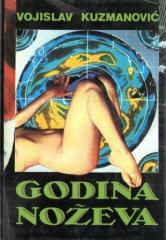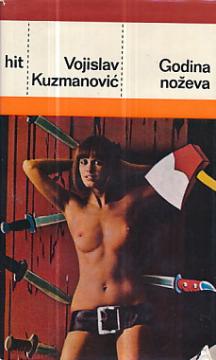
Godina noževa

Godina noževa

Vojislav Kuzmanović

The Year of Knives by Vojislav Kuzmanović is a psychological novel about a lonely intellectual who questions his life, marriage, and identity. The work depicts the crisis of the individual in contemporary urban society.

Year of Knives is the only novel by Croatian writer Vojislav Kuzmanović. The plot is set in contemporary Zagreb in the 1970s, and centers on a middle-aged intellectual going through a deep personal and existential crisis. The novel is designed as a kind of inner journey during which the main character questions his own decisions, relationships, and the meaning of life.

The story begins with his return from abroad, after a stay and lecture in Vienna. Returning home does not bring the expected sense of security, but confronts him with the disintegration of his private life. His relationship with his wife is burdened with mistrust and infidelity, and everyday life seems empty and devoid of deeper meaning. While he tries to establish control over his own life, he sinks more and more into a feeling of alienation and loneliness.

Through a series of memories, encounters, and inner monologues, the author depicts a man who fails to find a firm foothold in his family, his work, or the society that surrounds him. The title knives symbolize wounds that arise in interpersonal relationships, but also internal conflicts that destroy the individual. The novel explores themes of transience, sexuality, fear of illness, loss of identity, and the search for an authentic life.

Kuzmanović's style is marked by introspection and psychological analysis. Instead of external action, the emphasis is on the mental states of the protagonist and his attempt to understand his own existence. Year of Knives is considered a significant example of the Croatian urban and existentialist novel and a powerful literary testimony to man's loneliness in the modern world.

Editor
Zlatko Crnković
Titelseite
Alfred Pal
Maße
19,5 x 12 cm
Seitenzahl
254
Verlag
Znanje, Zagreb, 1976.
 
Latein Schrift. Fester Einband mit Schutzumschlag.
Sprache: Kroatisch.

Angeboten wird ein Exemplar

Zustand:Gebraucht, in gutem Zustand (Gebrauchsspuren)
Nachteile/Unannehmlichkeiten:
  • The cover is missing
  • Damaged covers
  • Traces of water
  • Library stamp
Zum Warenkorb hinzugefügt!
 

Interessieren Sie sich für ein anderes Buch? Sie können das Angebot über unsere Suchmaschine suchen und finden oder Bücher nach Kategorien durchsuchen.

Diese Titel könnten Sie auch interessieren

Godina noževa

Godina noževa

Vojislav Kuzmanović
Mladinska knjiga, 1990.
Kroatisch. Latein Schrift. Taschenbuch.
3,58
Večernji akt

Večernji akt

Pavao Pavličić

The story, centered on the brilliant forger Mihovil, criticizes the literature and art of our time. It also reflects on a society that is ready to adapt the coordinates of history to its own needs.

Znanje, 1981.
Kroatisch. Latein Schrift. Fester Einband mit Schutzumschlag.
3,98
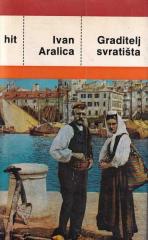
Graditelj svratišta

Graditelj svratišta

Ivan Aralica

The inn builder is a realistic historical novel, in the tradition of Andrić, but with elements of fantasy that connect Aralica with the oral Croatian literary word, but also with the fantastic literature of Gabriel García Marques, for example.

Znanje, 1987.
Kroatisch. Latein Schrift. Fester Einband mit Schutzumschlag.
7,26
Put u Jajce

Put u Jajce

Edvard Kocbek

In Put u Jajce, Edvard Kocbek provides personal and political testimony about key moments in Yugoslav history. The book is based on Kocbek's memories from the Second World War, especially the trip to Jajce in 1943.

Znanje, 1978.
Kroatisch. Latein Schrift. Fester Einband mit Schutzumschlag.
8,38
Naivci

Naivci

Ivan Kušan

This is a humorous and satirical story about life in a small Dalmatian town, told through the perspective of a naive but insightful narrator.

Znanje, 1975.
Kroatisch. Latein Schrift. Fester Einband mit Schutzumschlag.
3,64
Kako biti stranac

Kako biti stranac

George Mikes

How to Be a Foreigner by George Mikes is a humorous book in which the author, as an immigrant from Hungary, humorously describes British customs, mentality, and everyday life from the perspective of a foreigner.

Znanje, 1980.
Kroatisch. Latein Schrift. Fester Einband mit Schutzumschlag.
5,42