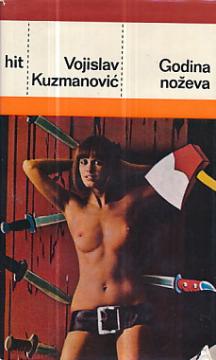
Godina noževa

Godina noževa

Vojislav Kuzmanović

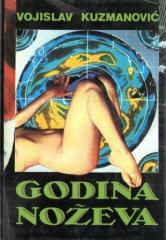
The Year of Knives by Vojislav Kuzmanović is a psychological novel about a lonely intellectual who questions his life, marriage, and identity. The work depicts the crisis of the individual in contemporary urban society.

Year of Knives is the only novel by Croatian writer Vojislav Kuzmanović. The plot is set in contemporary Zagreb in the 1970s, and centers on a middle-aged intellectual going through a deep personal and existential crisis. The novel is designed as a kind of inner journey during which the main character questions his own decisions, relationships, and the meaning of life.

The story begins with his return from abroad, after a stay and lecture in Vienna. Returning home does not bring the expected sense of security, but confronts him with the disintegration of his private life. His relationship with his wife is burdened with mistrust and infidelity, and everyday life seems empty and devoid of deeper meaning. While he tries to establish control over his own life, he sinks more and more into a feeling of alienation and loneliness.

Through a series of memories, encounters, and inner monologues, the author depicts a man who fails to find a firm foothold in his family, his work, or the society that surrounds him. The title knives symbolize wounds that arise in interpersonal relationships, but also internal conflicts that destroy the individual. The novel explores themes of transience, sexuality, fear of illness, loss of identity, and the search for an authentic life.

Kuzmanović's style is marked by introspection and psychological analysis. Instead of external action, the emphasis is on the mental states of the protagonist and his attempt to understand his own existence. Year of Knives is considered a significant example of the Croatian urban and existentialist novel and a powerful literary testimony to man's loneliness in the modern world.

Editor
Zlatko Crnković
Graphics design
Alfred Pal
Dimensions
19.5 x 12 cm
Pages
254
Publisher
Znanje, Zagreb, 1976.
 
Latin alphabet. Hardcover with dust jacket.
Language: Croatian.

One copy is available

Condition:Used, good condition (visible signs of use)
Damages or inconvenience notice:
  • The cover is missing
  • Damaged covers
  • Traces of moisture
  • Library stamp
 

Are you interested in another book? You can search the offer using our search engine or browse books by category.

You may also be interested in these titles

Godina noževa

Godina noževa

Vojislav Kuzmanović
Mladinska knjiga, 1990.
Croatian. Latin alphabet. Paperback.
3.58
Rakova djeca

Rakova djeca

Pavao Pavličić

Rakov's children are a tense read in which the editor of the black chronicle, Ivo Remetin, visits a friend who died in a traffic accident and becomes involved in an intriguing search for the killer of cancer patients.

Znanje, 1988.
Croatian. Latin alphabet. Hardcover with dust jacket.
5.32
Jesam li vam ikad lagao?

Jesam li vam ikad lagao?

Art Buchwald

Have I Ever Lied to You? by Art Buchwald is a collection of satirical stories and newspaper columns that humorously comment on politics, the media, and everyday life. He uses humor to expose the absurdities of contemporary society.

Znanje, 1981.
Croatian. Latin alphabet. Hardcover with dust jacket.
3.46 - 4.72
Konačna dijagnoza

Konačna dijagnoza

Arthur Hailey

Arthur Hailey's Final Diagnosis is a medical novel set in a large hospital. Through the fates of doctors and patients, it depicts responsibility, professional errors, and the conflict between tradition and progress in medicine.

Znanje, 1972.
Croatian. Latin alphabet. Hardcover with dust jacket.
4.42
Goli kruh

Goli kruh

Mohamed Choukri

Mohamed Choukri's novel Bare Bread is a powerful autobiographical story about poverty, hunger and the struggle for dignity in Morocco in the mid-20th century.

Znanje, 1988.
Croatian. Latin alphabet. Hardcover with dust jacket.
3.64
Graditelj svratišta

Graditelj svratišta

Ivan Aralica

The inn builder is a realistic historical novel, in the tradition of Andrić, but with elements of fantasy that connect Aralica with the oral Croatian literary word, but also with the fantastic literature of Gabriel García Marques, for example.

Znanje, 1987.
Croatian. Latin alphabet. Hardcover with dust jacket.
7.26