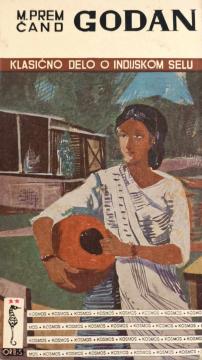
Godan

Godan

Munshi Prem Chand

In the small village of Belari, where the fields stretch like weary dreams, lived Hori, a man whose heart was deeply rooted in the land he tilled. He was a poor farmer, pious and faithful, with a wife, Dhania, who was the fire of his home—brave, eloquent, and just. They had three children: a son, Gobar, full of rebellious spirit, and two daughters, Rupa and Sona, who flourished in the shadow of suffering.

Hori’s dream was simple but sacred: a cow. Not just for milk and a plow, but for godaan—the ritual gift of a cow to a Brahmin, an act that would secure him a place in heaven. After years of starvation and debt, Hori finally bought a cow on credit from his neighbor Bhola. But fate, cruel as the monsoon, struck: Hori’s brother Heera, jealous and bitter, poisoned the animal. Heera's escape brought the police to Hori's door, and debts piled up like clouds – to loan sharks, landlords and customs.

Dhania stood by him, fighting with her tongue and hands against injustice. "We are the bones of this land!" she shouted at village meetings. Gobar, tired of the peasant yoke, fled to the city of Lucknow with Jhunia, the daughter of Bhola. Love united them, but the city separated them: Gobar became an entrepreneur in a factory, but, in a moment of weakness, he left Jhunia with his parents. Hori and Dhania, with hearts as wide as a river, accepted her as their daughter-in-law, violating the rules of caste and customs. The peasant panochayat punished them - they took away their oxen, leaving them without plowing.

But, despite all the adversities, Hori did not give up. Despite illness and losses, he remained a symbol of resistance - a man who worked the land with hands bloody with sweat, faithful to dharma. In the end, in agony, he donated his last rupee to a brahmin instead of a cow, whispering prayers. "Life is a gift, and suffering is a lesson," he said to Dhani, who was crying beside him.

Titel des Originals
Dar krave
Übersetzung
Zora Minderović
Editor
Čedomir Minderović
Maße
19 x 10,5 cm
Seitenzahl
2601
Verlag
Kosmos, Beograd, 1960.
 
Latein Schrift. Taschenbuch.
Sprache: Serbisch.

Weitere Exemplare sind verfügbar

Kopiennummer 1

Zustand:Gebraucht, in ausgezeichnetem Zustand
Zum Warenkorb hinzugefügt!

Kopiennummer 2

Zustand:Gebraucht, in ausgezeichnetem Zustand
Zum Warenkorb hinzugefügt!

Kopiennummer 3

Zustand:Gebraucht, in ausgezeichnetem Zustand
Zum Warenkorb hinzugefügt!
 

Interessieren Sie sich für ein anderes Buch? Sie können das Angebot über unsere Suchmaschine suchen und finden oder Bücher nach Kategorien durchsuchen.

Diese Titel könnten Sie auch interessieren

Tri mušketira 1-2

Tri mušketira 1-2

Alexandre Dumas

Dumasova verzija priče prikazuje avanture d’Artagnana i njegovih prijatelja od 1625 do 1628.

Epoha, 1966.
Kroatisch. Latein Schrift. Fester Einband mit Schutzumschlag.
Das Buch besteht aus zwei Bänden
9,48
Pustolovine Toma Sawyera

Pustolovine Toma Sawyera

Mark Twain

Pustolovine Toma Sawyera prvi je pravi realistički dječji roman, ne samo u američkoj nego i u svjetskoj dječjoj književnosti. Najpoznatije Twainovo djelo i omiljeno dječje štivo u kojem je pisac opisao svoje dječačke doživljaje.

Nakladni zavod Hrvatske, 1947.
Kroatisch. Latein Schrift. Hardcover.
16,32
Pišem ti priču : zbirka kratkih priča 6. natječaja za kratku priču Gradske knjižnice Samobor

Pišem ti priču : zbirka kratkih priča 6. natječaja za kratku priču Gradske knjižnice Samobor

Maja Klisurić, Draženka Robotić
Vlastita naklada, 2018.
Kroatisch. Latein Schrift. Taschenbuch.
2,90
Đavoli dolaze

Đavoli dolaze

Miodrag Bulatović
Rad, 1986.
Serbisch. Latein Schrift. Taschenbuch.
1,16
Dok ležah na samrti

Dok ležah na samrti

William Faulkner

Faulknerov roman iz 1930. godine, klasičan primjer modernističke književnosti. Često se uspoređuje s Joyceovim „Ulyssesom“ zbog inovativne strukture, ali je pristupačniji zahvaljujući fokusu na obitelji.

Rad, 1985.
Kroatisch. Latein Schrift. Taschenbuch.
3,26
Stotina godina (antikronika)

Stotina godina (antikronika)

Dario Harjaček

Roman Stotina godina Darija Harjačeka panoramski prikazuje Trešnjevku i njezine stanovnike kroz stoljeće promjena, ideologija i ljudskih sudbina – mozaik Zagreba u kojem se isprepliću život, umjetnost i povijest.

Oceanmore, 2025.
Kroatisch. Latein Schrift. Taschenbuch.
13,42