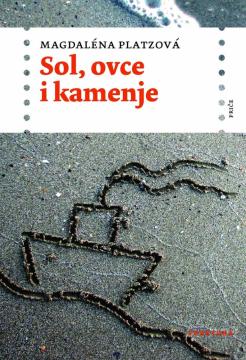
Sol, ovce i kamenje

Sol, ovce i kamenje

Magdaléna Platzová

A fresh, uninhibited literary view of Dalmatia. Four stories about Dalmatia told in the manner of the best pages of Czech literature. Bringing to life the scents of salt and sea, the author writes vivid prose full of color and flavor.

Magdaléna Platzová does not write about Dalmatia as a tourist passing through it. She enters it slowly, as if she were walking barefoot on hot stone, feeling every crack under her feet, every salt that seeps into the pores of her skin. This is not an exotic travelogue, nor a nostalgic postcard. This is intimate, almost tactile prose – prose that smells of dry grass, goat cheese, sea and dust.

Four stories, loosely connected, float between Split, Pag, the small islands and Prague, between the scorching summer and the biting winter. At the center are women – those who wait, those who leave, those who stay and those who return to realize that they no longer belong anywhere. Veronika carries a silent wound within her; the seasonal workers on the island live in the temporary, as if they themselves have become part of the summer inventory; and the title story, like an old Dalmatian song, sings of sheep grazing on bare stone, of salt that bites wounds, of life that does not change, only repeats itself.

Platzová writes with Czech precision and Mediterranean warmth – the sentences are short, but dense, full of air and light. There is no pathos, no sentimentality; only the deep, unobtrusive melancholy of those who have seen too much transience. The shadows of war hover somewhere in the background, but they do not shout – they are like distant thunder, a reminder that everything is fragile. And yet, in this fragility there is some strange constancy: the stone remains, the sheep move on, the salt crystallizes.

This is a book that is read slowly, as if drinking wine from a small glass – sip by sip, to taste the taste. It does not offer answers, it does not explain anything to the end. It only shows: this is what life looks like when two worlds collide – the one that rushes and the one that stands still. And when you close the book, you still feel the salt on your lips and the warmth of the stone under your palms.

Original title
Sul, ovce a kamení
Translation
Sanja Milićević Armada
Editor
Seid Serdarević
Illustrations
Tibor Fazakas
Dimensions
17 x 12 cm
Pages
142
Publisher
Fraktura, Zaprešić, 2006.
 
Latin alphabet. Paperback.
Language: Croatian.

One copy is available

Condition:Used, excellent condition
 

Are you interested in another book? You can search the offer using our search engine or browse books by category.

You may also be interested in these titles

Prelazni period: Dnevnik posmatrača

Prelazni period: Dnevnik posmatrača

Mihailo Lalić

„Prelazni period“ je roman crnogorskog i srpskog pisca Mihaila Lalića, objavljen 1988. godine. Rad ima podnaslov „Dnevnik jednog posmatrača“, što sugeriše introspektivan i refleksivan pristup pripovedanju.

Nolit, 1988.
Croatian. Latin alphabet. Hardcover.
7.52
Vrtoglavica

Vrtoglavica

Winfried G. M. Sebald

Sebald is not just a storyteller. His narrative process offers a model of consciousness that tells us: to be fully aware of oneself is to suffer from incurable vertigo.

Plato, 2020.
Serbian. Latin alphabet. Paperback.
6.52
I drugi su pjevali o ratu: Odjeci raspada Jugoslavije u engleskoj i američkoj književnosti

I drugi su pjevali o ratu: Odjeci raspada Jugoslavije u engleskoj i američkoj književnosti

Muharem Bazdulj

In this book of essays, Muharem Bazdulj analyzes how the collapse of Yugoslavia and the wars of the 1990s resonated in Anglo-Saxon literature – from pre-war stereotypes to war and post-war depictions.

Biblioteka XX vek, 2013.
Croatian. Latin alphabet. Paperback.
8.24
Imenik lijepih vještina I-II

Imenik lijepih vještina I-II

Miljenko Jergović

In The Directory of Fine Arts, Miljenko Jergović explores diverse topics, from literature to history, celebrating art and excellence. His essays offer deep understanding, imbued with intellectual passion and a love of the written word.

24 sata, 2018.
Croatian. Latin alphabet. Hardcover with dust jacket.
The book consists of two volumes
34.56
Dnevnici, 1. svezak: 1909-1912.

Dnevnici, 1. svezak: 1909-1912.

Franz Kafka

Kafka's diaries, published posthumously, reveal the inner world of an anxious genius. The first volume covers his early years, when Kafka worked as an insurance clerk in Prague, faced with a dreary life and literary ambitions.

Tim press, 2022.
Croatian. Latin alphabet. Paperback.
15.42
Eseji

Eseji

Skender Kulenović

Selected works, 4

Veselin Masleša, 1971.
Croatian. Latin alphabet. Hardcover with dust jacket.
7.82