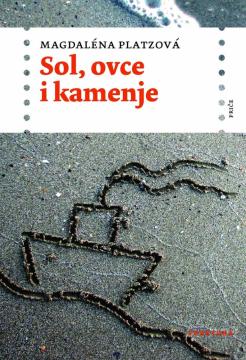
Sol, ovce i kamenje

Sol, ovce i kamenje

Magdaléna Platzová

A fresh, uninhibited literary view of Dalmatia. Four stories about Dalmatia told in the manner of the best pages of Czech literature. Bringing to life the scents of salt and sea, the author writes vivid prose full of color and flavor.

Magdaléna Platzová does not write about Dalmatia as a tourist passing through it. She enters it slowly, as if she were walking barefoot on hot stone, feeling every crack under her feet, every salt that seeps into the pores of her skin. This is not an exotic travelogue, nor a nostalgic postcard. This is intimate, almost tactile prose – prose that smells of dry grass, goat cheese, sea and dust.

Four stories, loosely connected, float between Split, Pag, the small islands and Prague, between the scorching summer and the biting winter. At the center are women – those who wait, those who leave, those who stay and those who return to realize that they no longer belong anywhere. Veronika carries a silent wound within her; the seasonal workers on the island live in the temporary, as if they themselves have become part of the summer inventory; and the title story, like an old Dalmatian song, sings of sheep grazing on bare stone, of salt that bites wounds, of life that does not change, only repeats itself.

Platzová writes with Czech precision and Mediterranean warmth – the sentences are short, but dense, full of air and light. There is no pathos, no sentimentality; only the deep, unobtrusive melancholy of those who have seen too much transience. The shadows of war hover somewhere in the background, but they do not shout – they are like distant thunder, a reminder that everything is fragile. And yet, in this fragility there is some strange constancy: the stone remains, the sheep move on, the salt crystallizes.

This is a book that is read slowly, as if drinking wine from a small glass – sip by sip, to taste the taste. It does not offer answers, it does not explain anything to the end. It only shows: this is what life looks like when two worlds collide – the one that rushes and the one that stands still. And when you close the book, you still feel the salt on your lips and the warmth of the stone under your palms.

Original title
Sul, ovce a kamení
Translation
Sanja Milićević Armada
Editor
Seid Serdarević
Illustrations
Tibor Fazakas
Dimensions
17 x 12 cm
Pages
142
Publisher
Fraktura, Zaprešić, 2006.
 
Latin alphabet. Paperback.
Language: Croatian.

One copy is available

Condition:Used, excellent condition
 

Are you interested in another book? You can search the offer using our search engine or browse books by category.

You may also be interested in these titles

Isus – čovjek koji živi

Isus – čovjek koji živi

Malcolm Muggeridge

A spiritual classic of the 20th century, one of the most famous and influential contemporary biographies of Jesus Christ, written by British convert, journalist, satirist, and television star Malcolm Muggeridge.

Kršćanska sadašnjost, 1983.
Croatian. Latin alphabet. Paperback with dust jacket.
18.36
Runje i pahuljice

Runje i pahuljice

Fran Kurelac

Runje i pahuljice by Frano Kurelc is a collection of selected literary and journalistic texts in which the author reflects on language, literature, and Croatian national identity. The work combines scholarship, patriotism, and stylistic playfulness.

Vlastita naklada, 1916.
Croatian. Latin alphabet. Hardcover.
16.42
Znamenovanje ruske revolucije

Znamenovanje ruske revolucije

Lav N. Tolstoj

Tolstoy interprets the 1905 revolution as a moral upheaval: violence does not bring justice, but a new yoke. He sees lasting liberation in personal conscience, non-violence and Christian love, not in the state and coercion.

St. Kugli, 1907.
Croatian. Latin alphabet. Hardcover.
17.24
Na zelenom otoku: Putopis iz Irske

Na zelenom otoku: Putopis iz Irske

Josip Andrić

"On the Green Island" by Josip Andrić (1932, 2nd ed. 1934) is a travelogue from Ireland. A lively and warm description of Irish nature, history, culture and people, full of sympathy for the small Catholic nation and its fight for freedom. Illustrated edit

Vlastita naklada, 1934.
Croatian. Latin alphabet. Hardcover.
4.32
Čovjek

Čovjek

Maksim Gorki

Man by Maxim Gorky, translated by Ozren Subotić (Vukovar, 1905), is a philosophical and literary work that glorifies the dignity of man, his creative power, freedom of spirit, and the fight against social injustice.

Srijemske novine, 1905.
Croatian. Cyrillic alphabet. Paperback.
17.56
Spašavala sam brak, a spasila sebe

Spašavala sam brak, a spasila sebe

Vesna Oršulić

In her candid autobiographical book, Vesna Oršulić describes how, through therapeutic writing and prayer, instead of saving her 20-year-old marriage, she saved herself. From despair and anger to a happy, independent woman.

Rafinerija ideja, 2022.
Croatian. Latin alphabet. Paperback.
7.32