Friedrich Nietzsche
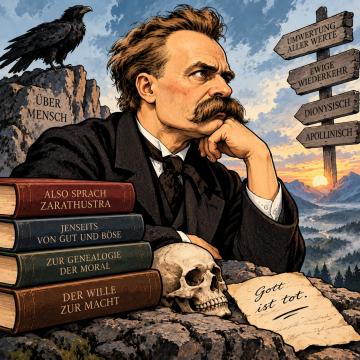
Friedrich Wilhelm Nietzsche (Röcken, 1844 – Weimar, 1900) was a German philosopher, philologist, and essayist, and one of the most influential thinkers in modern European culture. He studied classical philology in Bonn and Leipzig, and at the age of just twenty-four, he became a professor of classical philology at the University of Basel. Due to health issues, he left his academic career in 1879 and spent the following decade primarily traveling and writing.
His first major work, The Birth of Tragedy (1872), examines Greek culture through the contrast between the Apollonian principle of order and the Dionysian drive, ecstasy, and creative energy. In the works Human, All Too Human (1878), Daybreak (1881), and The Gay Science (1882), Nietzsche develops an aphoristic style and increasingly criticizes traditional metaphysics, religion, and morality.
A central place in his body of work is held by the philosophical-poetic work Thus Spoke Zarathustra (1883–1885), which introduces the ideas of the Übermensch (Overman/Superman), the overcoming of man, and eternal recurrence. In the books Beyond Good and Evil (1886) and On the Genealogy of Morality (1887), he explores the origins of moral values and questions their alleged universality.
Notable among his later works are The Case of Wagner, Twilight of the Idols, The Antichrist, Ecce Homo, and Nietzsche contra Wagner. Concepts such as the will to power, perspectivism, nihilism, and the "death of God" became indispensable in later philosophical discussions. The book known as The Will to Power is not a completed work authored by Nietzsche himself, but rather a posthumous compilation of his notes.
In 1889, Nietzsche suffered a severe mental breakdown in Turin, after which he produced no further work. He spent his final years in the care of his family.
His philosophy profoundly influenced existentialism, phenomenology, psychoanalysis, literature, and 20th-century philosophy. Nietzsche’s distinctive blend of philosophy, psychology, literature, and cultural criticism made him one of the most widely read—yet also most diversely interpreted—thinkers of the modern era.
Titles in our offer

Knjiga o filozofu
Provocative philosophical fragments concerning the role of the philosopher, the nature of truth, and the conflict between art, science, and knowledge. Nietzsche raises questions that would come to define his later philosophy.