Danilo Kiš

Danilo Kiš (Subotica, February 22, 1935 – Paris, October 15, 1989) was a Yugoslav writer, storyteller, essayist, and translator, and one of the most significant authors of South Slavic and European literature in the second half of the 20th century. He grew up in a family with a Hungarian-Jewish father, Eduard Kiš, and a Montenegrin mother, Milica Dragićević. His childhood—marked by World War II, the persecution of Jews, and the disappearance of his father in the Holocaust—fundamentally shaped his literary world.
After the war, he lived in Cetinje and subsequently studied comparative literature at the Faculty of Philosophy in Belgrade. He worked as a translator and proofreader, spending a significant part of his life in France. He translated from French, Hungarian, and Russian, rendering works by Baudelaire, Verlaine, and Hungarian poets, among others.
He published his first books—the novels Mansarda (The Attic) and Psalam 44 (Psalm 44)—in 1962. A special place in his body of work is held by the autobiographical cycle known as Porodični cirkus (Family Circus), comprising Rani jadi (Early Sorrows), Bašta, pepeo (Garden, Ashes), and Peščanik (Hourglass). In these works, Kiš reconstructs a vanished Central European world and the fate of his own family through a child's perspective, documents, memories, and literary imagination. International attention was drawn by the collection A Tomb for Boris Davidovich (1976)—seven stories concerning revolutionaries, political violence, Stalinist show trials, and the mechanisms of totalitarianism. The book sparked a major literary controversy and accusations of plagiarism, to which Kiš responded with the polemical essay collection The Anatomy Lesson.
His most important works also include The Encyclopedia of the Dead, Homo Poeticus, and posthumously published texts collected in the volumes Life, Literature and The Lute and the Scars. His prose blends documentary elements, autobiography, irony, history, and postmodernist literary techniques.
Kiš focused particularly on themes of memory, death, identity, the Holocaust, and totalitarianism. Through a precise style and a keen awareness of literary form, he created a body of work that transcends national literary boundaries; today, he is regarded as one of the key Central European writers of the 20th century.
Titles in our offer
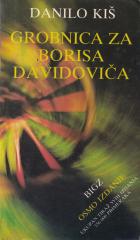
Grobnica za Borisa Davidoviča
Seven stories about revolution, ideology and political terror reveal the destinies of people caught in the mechanisms of totalitarian government, where history, fear and betrayal determine people's lives.
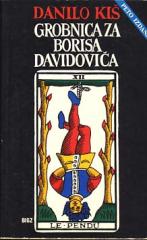
Grobnica za Borisa Davidoviča
This collection of seven interconnected stories deals with the victims of Stalinist purges and 20th-century political ideologies, blending historical facts, fiction, and a documentary style.
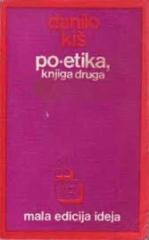
Po-etika, knjiga druga
A collection of interviews that complements the first book of essays from 1972. As a lecturer in Serbo-Croatian at the University of Bordeaux, Kiš reveals in conversations the core of his "po-ethics" - a morally and aesthetically charged vision of literat