Carlos Castaneda
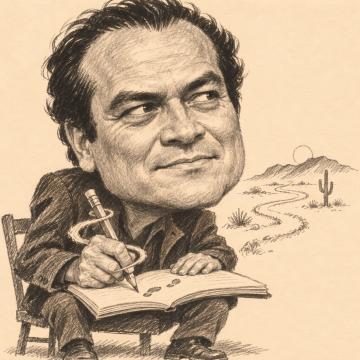
Carlos Castaneda (Cajamarca, Peru, 1925 – Los Angeles, 1998) began his best-known story with a chance meeting at a bus station. By his own account, he met Don Juan Matus there in 1960 as an anthropology student looking for someone who could tell him about the use of psychoactive plants. In his telling, that man became a teacher who pushed him to question everything he thought he knew about the world.
Castaneda studied anthropology at the University of California, Los Angeles. The university press published his first book, The Teachings of Don Juan: A Yaqui Way of Knowledge (1968). He portrays Don Juan as a Yaqui man and describes their encounters from the point of view of a bewildered apprentice. Don Juan often answers with a question or a joke, and the apprentice’s urge to explain everything at once drives some of their best exchanges.
Castaneda continued the story of his apprenticeship in A Separate Reality (1971) and Journey to Ixtlan (1972). Experiences with plants play an important role in the first book, while Journey to Ixtlan brings attention and habits of perception to the fore. Tales of Power (1974) followed, and in the later The Art of Dreaming (1993), Castaneda focused on the possibility of acting consciously within dreams.
The books became bestsellers among readers of the counterculture in the late 1960s and early 1970s. Their influence reached into the New Age movement, where Castaneda’s vision of shamanism found a new audience. Part of the appeal lies in the way he tells the story: readers learn only as much as the bewildered apprentice can understand at the time.
As the readership grew, so did doubts about the books’ reliability. Don Juan Matus’s existence was never independently confirmed, and critics questioned the connection between the teachings attributed to him and Yaqui traditions. That debate still follows Castaneda’s books and shapes how we read them: how far can we trust a narrator whose story is itself about doubting what we see?
Naslovi u ponudi
Drugi krug moći
Castaneda's fourth book, which continues his journey through the world of Mexican shamanism, but with a new focus: relationships with Don Juan's female students and deepening the teachings on the dual aspect of consciousness - the first and second circles
Odvojena stvarnost: Nastavak razgovora s don Huanom
"A Separate Reality" is the second book by Carlos Castaneda in which the author continues to document his teachings with Don Juan Matús, an Indian shaman from Mexico. The book's afterword was written by Mirko Magarašević.
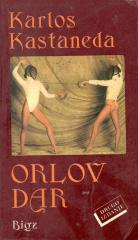
Orlov dar
The Eagle's Gift is not just a shamanic manual, but also a philosophical meditation on the nature of reality, death, and the possibility of transcendence. Castaneda invites the reader to question their own beliefs about the world and open themselves to ne
Orlov dar
The sixth book in the series about Castaneda's studies with don Juan Matus, a Yaqui shaman. The novel continues Castaneda's spiritual and philosophical quest, focusing on the concept of the "Eagle's Rule" and the transition to a deeper understanding of sh
Priče o moći
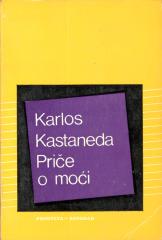
Don Juan i don Genaro vode Castanedu prema završnici naukovanja. Razgovori o tonalu i nagualu, pozornosti i unutarnjoj tišini prerastaju u zagonetnu priču o granicama razuma i promjeni percepcije.
Put u Ihtlan
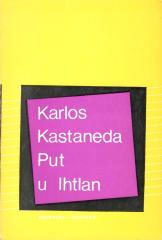
"Put u Ihtlan" treća je objavljena knjiga Carlosa Castanede, iako kronološki predstavlja rani dio njegova učenja s Don Juanom. Ova knjiga donosi prekretnicu u Castanedinu narativu – manje o halucinogenima, a više o mudrosti, prisutnosti i samospoznaji.
Učenje don Huana
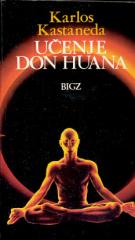
The book describes the author's apprenticeship with the Yaqui shaman don Juan. Through the use of psychotropic plants, Castaneda explores the non-artistic levels of reality and attempts to master the path of the "man of knowledge."