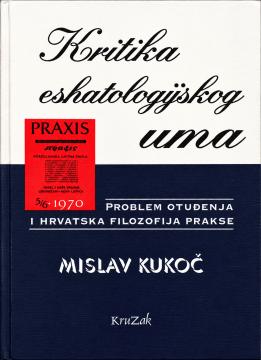
Kritika eshatologijskog uma
Mislav Kukoč traces the idea of alienation from classical German philosophy and Marx to Croatian praxis philosophy, asking whether social transformation can overcome it.
In Kritika eshatologijskog uma, Mislav Kukoč examines how alienation became a philosophical problem and how it came to occupy a central place in Croatian praxis philosophy. The discussion moves from Kant’s turn in philosophy and Fichte’s account of the subject’s self-activity through Schelling and Hegel to Marx, who applies the concept of alienation to labour and social relations.
Kukoč then considers how Croatian thinkers took up and developed the concept. He compares the contributions of Milan Kangrga, Vanja Sutlić, Predrag Vranicki and Rudi Supek and examines the connections between alienated labour and creative activity, and between ideology and reification. He also considers what alienation means in debates about civil society, the state, socialism and post-industrial society.
The final part asks how alienation might be overcome. What would it mean in practice to abolish labour, for the state to wither away, or to bring an authentic human community into being? Kukoč looks at the place of these ideas in historical, revolutionary and utopian thought and examines the assumptions behind the hope that alienation can be overcome once and for all.
Jedan primerak je u ponudi